

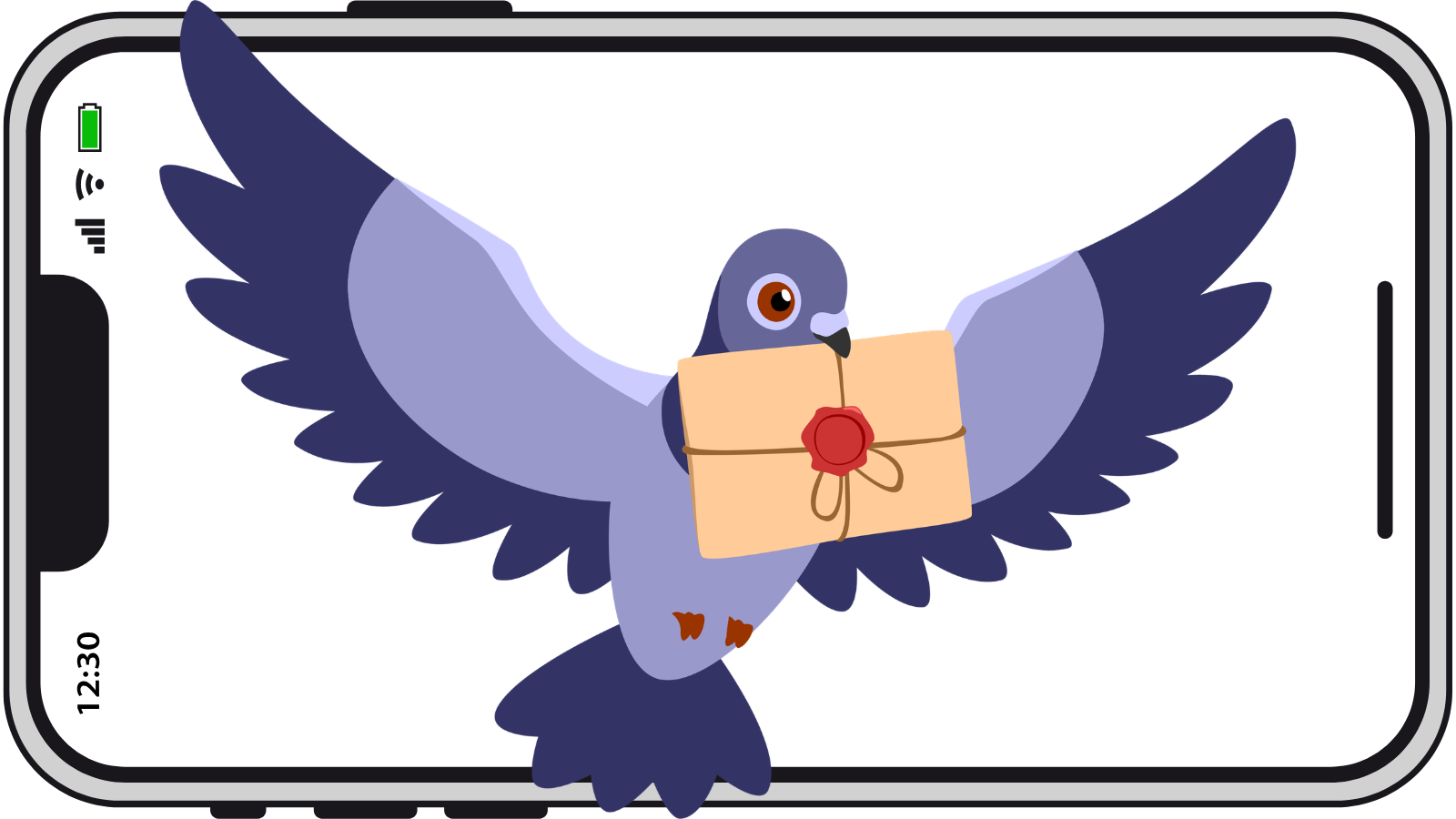
Gen Z has turned retro-fetishism into an art form. From dumbphones and wired earbuds to vinyl records and analog cameras, they have routinely revived obsolete tech to carve out stability in an hyper-connected world. But their latest obsession doesn’t stop at raiding the twentieth century—it leaps back hundreds of years. The new craze? Sending letters by carrier pigeon. And, with the usual cinematic disclaimer, no birds are harmed in the process: these pigeons are entirely digital.
Enter the rise of “slowcial” platforms—a mashup of slow and social—designed to make messaging intentionally sluggish. On Carrier Pidge, built by American developer Noah Iarrobino, dispatching a note from Delhi to Bengaluru takes roughly 10 to 12 hours. Launched in April, the app lingered in relative obscurity before an August social media post went viral, sending its download numbers surging.
A competing platform, Roost, founded by Logan Mendelsohn, takes the concept even further. Users can send messages via more than 1,000 virtual creatures, each calibrated to real-world biology. Send a dispatch via snail and it crawls forward at barely 1.5 kilometers per hour; an owl covers roughly thirty kilometers in the same span. Both apps feature live maps to trace a delivery’s progress, capping speeds around 177 km/h. On Carrier Pidge, there is even a 0.2 percent chance your bird gets lost or dies en route—requiring a 99-cent fee to dispatch a replacement. Roost, meanwhile, incorporates a global “Pen Pal” feature that pairs users with complete strangers.
Why embrace synthetic inefficiency? Speaking to The New York Times, Iarrobino framed the app as part of the broader “slow-tech” counterculture—a refuge for people exhausted by relentless digital tethering. Mendelsohn echoed this to TechCrunch, noting that hyper-connectivity turns daily life into an unending barrage of pinging alerts. Slowing down communication, they argue, restores gravity, intimacy, and intentionality to everyday exchanges.
This fatigue is well-documented. A 2023 survey revealed that over half of Gen Z respondents felt technology was isolating people rather than bringing them together. Their pivot toward feature phones, paper journals, and physical maps is not a wholesale rejection of technology, but an attempt to renegotiate its terms. In tech circles, this sentiment has fueled an “anti-design” movement: stripping away friction-free, dopamine-engineered interfaces in favor of deliberate friction and utilitarian simplicity.
By engineering delivery delays, these apps introduce what product designers call “manufactured friction.” Developers argue that delaying gratification breaks the dopamine loop of instant replies while injecting playful, game-like suspense into the wait. There is also a clever commercial model at work: free downloads monetized through minor microtransactions (like buying a replacement pigeon) rather than invasive surveillance advertising or data brokering—practices Gen Z actively avoids.
Yet whether artificial slowness can cure digital exhaustion remains an open question. In practice, slowcial apps might simply invent a new strain of screen addiction. Instead of doomscrolling, users may find themselves compulsively checking the map to see where their virtual bird has reached—behaving less like romantic letter-writers and more like hungry customers obsessively tracking a delivery rider on Swiggy or Zomato.
There is also the question of utility. In a fast-moving world, can slowcial apps replace instant messaging, or will they simply sit alongside WhatsApp and Telegram as another icon cluttering the screen? And once the novelty wears off, delayed messages can still pile up, delivering the exact deluge of notifications users sought to escape—just on a time lag.
Developers insist that delayed replies will compel people to write thoughtful, comprehensive letters. But if length and gravitas were the goal, email has existed for decades. When users know a message will take half a day to arrive, the result is just as likely to be playful melodrama or fleeting romanticism as it is profound prose. The true source of digital burnout has never been transmission speed; it is the suffocating social expectation of immediate availability.
Ultimately, the phenomenon fits neatly into the broader ‘nostalgia economy.’ Having already recycled the fashion, gadgets, and aesthetics of past decades, Gen Z treats digital culture as an experiential playground. In an internet ecosystem defined by frictionless immediacy, waiting has become the ultimate novelty—and young users are even willing to pay for it.
Subscribe to get updates, bookmark, or comment.