

By Sanjay Dubey
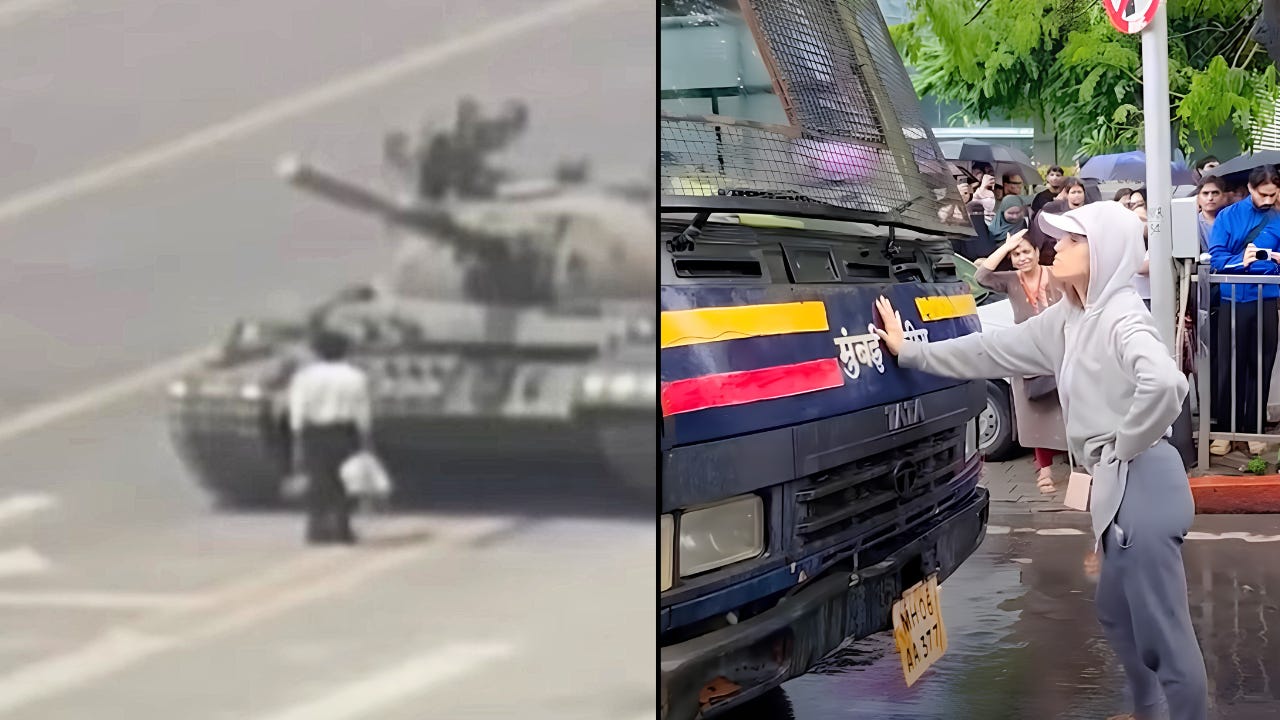
Rarely does a single human frame capture a generation’s defiance in an unforgettable visual. Standing on a rain-soaked road near Dadar’s Shivaji Park, 27-year-old Rhiya Ahir created one of those moments. As a police transport van packed with detained student protesters pushed forward, she stepped directly into its path—arm raised, refusing to budge.
For anyone versed in the lineage of global civil defiance, the visual instantly summoned a phantom from the past: Beijing’s Tiananmen Square in June 1989. Thirty-seven years and more than five thousand kilometers apart, an ordinary citizen stood unarmed against the machinery of state authority. Yet while the visual memory of “Tank Man” stopping a column of 18 military tanks remains shrouded in historical tragedy, Rhiya Ahir’s standoff in Mumbai offers a vibrant, modern testament to citizen intervention in a constitutional democracy.
On the day of the protest, Rhiya was waiting for her friends inside her house. Listening to the slogans coming from the street, she decided she couldn't wait any longer. Stepping outside to join the demonstration, she witnessed police loading young students into a transport van—and moved instinctively to block its path.
Rhiya comes from a military family, a background she credits for her courage and composure. Her father served in the Indo-Tibetan Border Police (ITBP), and her extended family has a long history of military service. Drawing from that lineage, she expresses a desire to join the armed forces herself, believing civic service or military training should be mandatory for everyone.
In the immediate aftermath, as images of her stand dominated social media feeds across India, Rhiya was thrust into the spotlight. In an interview with journalist Rajdeep Sardesai on India Today, when asked if she felt like a hero or if this was merely an “Instagram moment,” Rhiya shrugs off the hype, saying: “I ain’t no hero, I am only a part of a nation that wants to be heard.”

During her conversation with Sardesai, Rhiya forcefully dismantles the prevailing stereotype that younger generations are politically passive or superficial. Reframing the narrative around her peers, she offers a powerful new moniker for Gen Z. She declares that the ‘Z’ in Gen Z stands for Ziddi—resolute, defiant, and unwilling to compromise on fundamental values and rights. “We are not interested in politics,” she tells Sardesai, “we are interested in protecting our rights and protecting our country.”
In another interview with journalist Barkha Dutt on Mojo Story, Rhiya Ahir reveals that her stand was far more than a spontaneous gesture—it was a smart and legally aware act.. While onlookers saw a young woman holding her ground, Rhiya was actively using her smartphone to collect proof—photographing the vehicle’s license plate and recording the encounter to remain as legally protected as possible.
As she held the police vehicle at a standstill for several minutes, traffic backed up, creating a window of opportunity that allowed the detained student protesters at the rear of the van to hop off to freedom.
Pushing back against the common accusation that Gen Z takes nothing seriously, she notes, “whatever we don’t understand, we think it is wrong.” Rhiya explains further, sharing that she purposefully wears orange to send a message: the color “has not been bought by any political party... it is our national flag’s first color, which stands for courage and sacrifice.”
Credit for her conviction, she insists, belongs to her upbringing. Speaking fondly of her mother’s quiet resilience as a homemaker, she shares that her seva-bhav (spirit of service and empathy) comes from her mom, her support comes from her dad, and the courage is her own.
While the visual comparison between what Rhiya did in Mumbai and Tiananmen Square’s “Tank Man” is natural, the two events played out in vastly different political environments. In 1989 Beijing, an anonymous man faced heavy military armour under an authoritarian regime where dissent was met with brutal suppression. His identity and ultimate fate remain lost to history.
In 2026 Mumbai, Ria Ahir stood before a police vehicle as a citizen in a democracy grappling with its challenges. Armed with a smartphone, an awareness of legal protocols, and media platforms to share her voice, her stand was not an act of hopeless martyrdom, but, as she calls it, a "Ziddi" assertion of her rights and demand for official accountability.
Rhiya’s “Sheroism” lies not just in stopping a police van, but in reminding a modern nation of a timeless truth: democracy is not a passive spectator sport.
Yet, a deeper similarity connects them both: whether 37 years ago or today, when ordinary citizens decide that their conviction is greater than their fear, even the heaviest vehicles of authority can be forced to a halt.
Subscribe to get updates, bookmark, or comment.