

By Sanjay Dubey
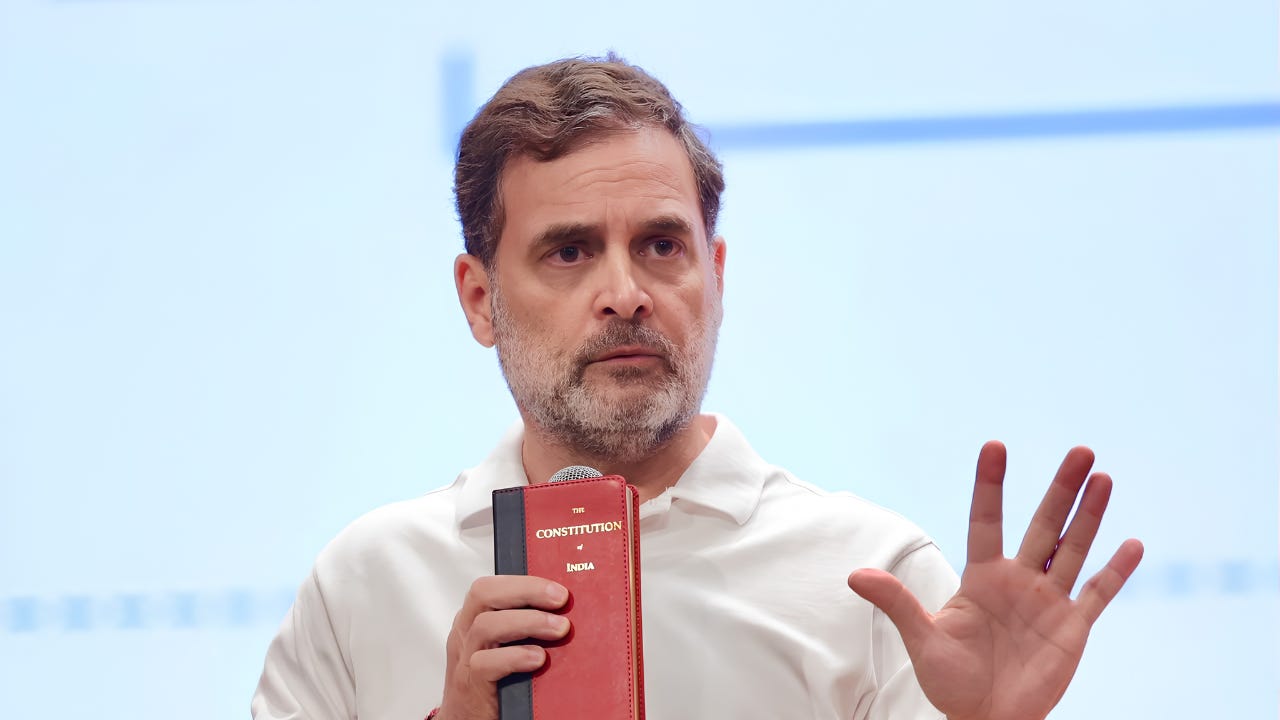
During a recent press conference, India Today journalist Mausami Singh put a direct question to Rahul Gandhi: “Sir, will there be a point that you will boycott the elections? Will it come to that?”
Gandhi did not pause to ponder scenarios or hedge his bets. He shut the question down immediately: “Main us distraction mein nahi jaunga (I will not get into that distraction.)… I will avoid the distraction. But thank you.”
But there are many others who do not find this question to be a distraction. Abhijeet Dipke, the strategist behind the youth-centric Cockroach Janta Party (CJP), issued an impassioned plea on social media urging the entire opposition to walk away from the ballot box. His argument was direct: by participating in elections they allege are rigged, opposition parties merely legitimise the process and maintain the illusion of a functioning democracy. Contesting for survival, Dipke argued, is self-delusion when parties are routinely split, lawmakers poached, and votes manipulated. Comparing the system to a fixed cricket match where a few catches are deliberately taken to make the contest look real, he argued that occasional opposition wins are just “crumbs” meant to keep them trapped in the game.
The sentiment resonates with many citizens exhausted by controversies over the independence of the Election Commission, opaque voter roll deletions, and skewed institutional playing fields. Yet, Gandhi’s curt refusal to entertain the idea and Trinamool Congress leader Derek O’Brien’s sharp public rebuttal of Dipke’s plea reveal a profound gulf. It is the divide between the moral absolutism of a young activist and the cold, unyielding mechanics of electoral politics.
The fundamental flaw in the boycott argument lies in a basic misunderstanding of Indian electoral law: the constitutional machinery does not pause for non-participants.
In corporate boardrooms or international organisations, a vote often requires a quorum to be legally valid. If half the members walk out, business halts. But Indian parliamentary democracy makes no distinction between voter turnout of 80% and 8%.
If every major opposition party refused to field candidates, the BJP and its allies could win a huge number of Lok Sabha seats, with some potentially going uncontested.
This is the scenario Derek O’Brien warned against when he countered Dipke: “Opposition boycotting elections = BJP wins all seats. Once that happens, they amend the Constitution to legalise all their crimes.”
An opposition-free Lok Sabha would give a ruling alliance enormous legislative room, with no resistance to ordinary legislation. Constitutional amendments would still require a special majority in the Rajya Sabha, and some would also require ratification by at least half the states. But if the opposition extended its boycott to some Assembly elections, even those safeguards could weaken: state legislators elect most Rajya Sabha members, and the BJP-led NDA already governs more than 20 states. A boycott, therefore, does not paralyse an incumbent government. The wider it spreads, the more institutional ground the opposition risks surrendering.
Some strategists argue that even if an opposition does not actually walk away, merely threatening a boycott could serve as a formidable tactical weapon. If backed by a disciplined and united alliance, an ultimatum could act as an effective bargaining chip.
Yet, this gambit carries an almost fatal catch: the risk of a called bluff.
If an opposition alliance issues an ultimatum that the government ignores, it faces a no-win scenario. Boycotting the election hands absolute legislative power to the ruling party and leads to irrelevance, while backing down to contest anyway proves its threat was empty noise.
This high-stakes trap explains why Rahul Gandhi refused to open that rhetorical door even an inch. In hard-nosed politics, you never brandish an ultimatum you cannot afford to execute.
Modern political history offers numerous examples of election boycotts leaving the parties that launched them weaker rather than stronger. Across different decades and continents, regimes have often treated an opponent’s walkout not as a crisis of conscience, but as an administrative gift.
Punjab, 1992
After five years of direct President’s Rule amid intense militant insurgency, the Union government scheduled Punjab Assembly elections in February 1992. Faced with militant threats and unresolved regional grievances, major factions of the Shiromani Akali Dal decided to boycott the polls to deny the Indian state legitimacy in the region.
The boycott helped depress turnout to just 23.8%, with participation particularly low in rural areas. But the outcome was decisive: the Indian National Congress swept 87 of the 117 seats. Beant Singh formed the government despite the exceptionally low turnout. For the next five years, the Akali Dal had no representation in the legislature and little formal influence over state policy while counter-insurgency operations continued. By 1997, recognising the depth of the strategic blunder, the Akalis returned to the ballot box.
Venezuela, 2005
Ahead of the December 2005 parliamentary elections, Venezuela’s mainstream opposition parties accused President Hugo Chávez of packing the National Electoral Council and manipulating automated voting machines. Convinced that participation would legitimise a compromised process, the opposition pulled its candidates just days before the vote.
Voter turnout fell to about 25%, but the legal consequence was absolute: pro-Chávez forces captured all 167 seats in the National Assembly. Without an opposition presence to register dissent, Chávez gained sweeping powers and packed key institutions with loyalists. The opposition then spent years trying to recover the institutional ground it had surrendered.
Bangladesh, 2014
In 2011, Prime Minister Sheikh Hasina’s government abolished the neutral “Caretaker Government” system. Khaleda Zia’s Bangladesh Nationalist Party (BNP) demanded its restoration and eventually boycotted the 2014 general election, asserting that no fair election was possible under the Awami League’s direct watch.
Because of that, 153 out of 300 parliamentary seats were decided completely uncontested before a single citizen cast a ballot. The Awami League and its allies secured an overwhelming parliamentary majority. Far from collapsing under international opprobrium, the government remained in power for another decade. Sidelined outside Parliament, the BNP lost an important institutional platform as its organisational network came under growing pressure and much of its leadership faced arrests, cases or exile.
An election boycott can only succeed if it is the opening act of a sustained mass movement. This was how the Indian National Congress under Mahatma Gandhi used boycotts against colonial authorities, backed by nationwide non-cooperation.
Does today’s Indian opposition possess such capability?
The clearest example in recent years of a movement forcing the Union government into a major policy retreat was the 2020–2021 farmers’ agitation against the three farm laws. But that struggle drew its staying power from non-partisan agrarian networks—khaps, village panchayats, and community-funded logistical supply chains—and its leaders deliberately kept political parties off their stages to prevent the state from dismissing the movement as an electoral conspiracy. A boycott declared from party headquarters would hardly find such organic machinery waiting to paralyse the nation for any sustained period.
Dipke’s Cockroach Janta Party also showed genuine agility when its high-voltage sit-ins at Jantar Mantar over exam irregularities and paper leaks culminated in Union Education Minister Dharmendra Pradhan’s resignation. Yet that episode also illuminated the sharp ceiling of urban, issue-based agitation.
Forcing an individual cabinet minister to step down over a specific, visible administrative mess in the national capital is worlds apart from shutting down a subcontinent. A protest at Jantar Mantar, largely driven by viral online momentum and metropolitan students, lacks the institutional depth, geographical reach and economic leverage required to bring state machinery to a halt across 28 states.
Calls for an election boycott also seem to ignore the human reality of retail politics. A political party does not live in television studios or social media feeds; it lives in municipal wards, village booths and district courts.
As Derek O’Brien noted in his post, thousands of party workers contest elections at various levels, backed by crores of supporters, while facing police scrutiny and putting their lives and livelihoods on the line. Contesting elections is the oxygen that keeps this network alive. It offers local leaders and workers visibility, protection and influence. If a party leadership announces that it will simply sit out elections for the next five years, that cadre cannot hibernate. Deprived of political shelter and facing pressure from the ruling machinery, local workers either defect to the ruling party or retire from public life entirely. An unused political machine does not stay pristine; it rusts.
This is also why Rahul Gandhi dismissed the question as a “distraction.” To publicly entertain a boycott is an immediate political trap. The moment an opposition leader validates the idea, the national conversation can stop being about allegations of electoral manipulation, arbitrary institutional conduct or economic distress. Instead, the narrative can become one of an opposition conceding defeat and running away from the battlefield.
For parties that reject a boycott, the alternative is unglamorous, exhausting and often unfair. It involves scrutinising wrongdoing, mobilising people, fighting on the streets and in the courts, guarding every name on the electoral rolls, guarding polling booths, and staying on the ballot rather than voluntarily surrendering democratic space.
Subscribe to get updates, bookmark, or comment.