

By Sanjay Dubey
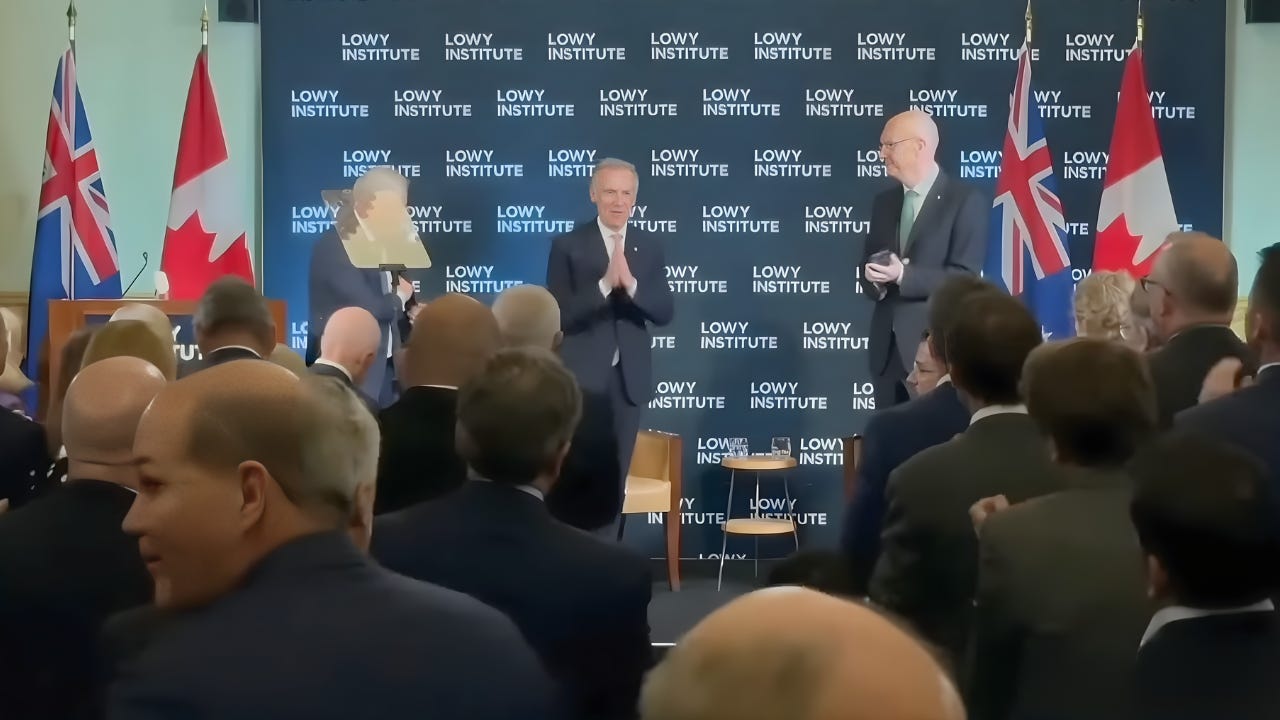
On March 4, 2026, during a discussion at the Lowy Institute in Sydney, Canadian Prime Minister Mark Carney ended his remarks with an unusual gesture. Instead of waving or nodding, he briefly pressed his palms together to thank the audience.
It was a small, almost reflexive moment at the end of a high-stakes program that many might not have even noticed. But for those who did, it might have triggered a vivid memory of exactly six years ago.
It was March 2020, when the COVID-19 pandemic first tightened its grip on India, forcing a nationwide lockdown. At that time, the world was scrambling for ways to say “hello” or “thank you” without risking infection. Six years later, seeing one of the most educated leaders of the G7 fold his hands in a high-level forum in Australia suggests a deeper reality: India’s most widely used body gesture has moved beyond a cultural symbol to become a global symbol of hygienic, sincere, and refined etiquette.
The Indian folded-hand gesture, called the Anjali Mudra, is rooted in the Vedas and the Natya Shastra. It has always served a multi-dimensional purpose: it is the posture of worship, the standard social greeting (Namaste), and a profound expression of gratitude. And these are not separate from each other. Whether you say “hello” or a heartfelt “thank you,” you also acknowledge a spiritual presence in the other person.
In the West, folded hands (palms together) were never a gesture of greeting. They emerged by the early medieval period and became widespread in the Middle Ages as a symbol of submission and loyalty. A weak vassal’s folded hands stretched toward a lord was a show of submission. This was later transposed into Christian prayer to signify submission to God.
In Jewish tradition too, folded hands appear in early descriptions of prayer. The Babylonian sage Rabba bar Nachmani is described in the Talmud as praying with folded hands, suggesting that the gesture was also known in parts of the ancient Middle East as an expression of reverence.
For centuries, these two versions lived parallel lives: the Indian one as a multi-purpose cultural symbol, and the Western one used strictly for addressing the divine.
This was not the case in several other parts of the world, especially across Asia. Long before COVID-19, the Anjali Mudra had already become part of daily life in many societies. Between the 1st and 13th centuries, as Hinduism and Buddhism spread across Asia, the folded-hands greeting evolved into local forms: the wai in Thailand, the sampeah in Cambodia, the nop in Laos and gassho in Japan.
But until recently, Westerners mostly encountered this gesture as tourists or through the global rise of yoga and meditation. In the West, it was something “exotic” that you did at the end of a class or while experimenting with Indian spirituality. But they rarely folded their hands while meeting a bank manager, greeting a prime minister, or expressing gratitude.
The year 2020 changed the way humans interact. As the pandemic struck, the most fundamental Western social ritual—the handshake—was revealed to be a primary vector for disease.
Historically, Western discourse had often labeled Indian social habits as “unhygienic.” But as the world entered the COVID era, the script was flipped. Namaste was suddenly the world’s most hygienic greeting. It then saw rapid adoption by world leaders who had long been committed to the “firm handshake.” Donald Trump, Emmanuel Macron, and Charles III were all seen using the gesture during the height of the crisis.
But when Mark Carney used the gesture at the Lowy Institute, he wasn’t being cautious about germs. He appeared to be using it as a natural cultural expression of gratitude. What makes this especially striking is that he did so at a time when India’s global voice appears deeply subdued.
It may signify something more as well. In a world where Carney argues that middle powers must increasingly set the agenda, adopting the greeting of the world’s most populous democracy becomes a powerful symbol—signalling a shift toward a multipolar world that treats others with humility and respect.
So far, the West has adopted only the “base version” of India’s folded-hands gesture for safety and gratitude. It has yet to learn its grammar. Many may not realise that when palms are joined at chest level, it signals equality, while a slight forward bend makes the greeting more respectful.
They may also learn that folded hands touching one’s forehead can signal extreme respect. With subtle variations, the same gesture can even express sarcastic submission—or, in certain postures, quiet arrogance.
Perhaps that last variation might even make the gesture attractive to the Donald Trumps of the world—who may not find its humble versions as appealing in normal times as they did during the pandemic.
Subscribe to get updates, bookmark, or comment.