

By Sanjay Dubey
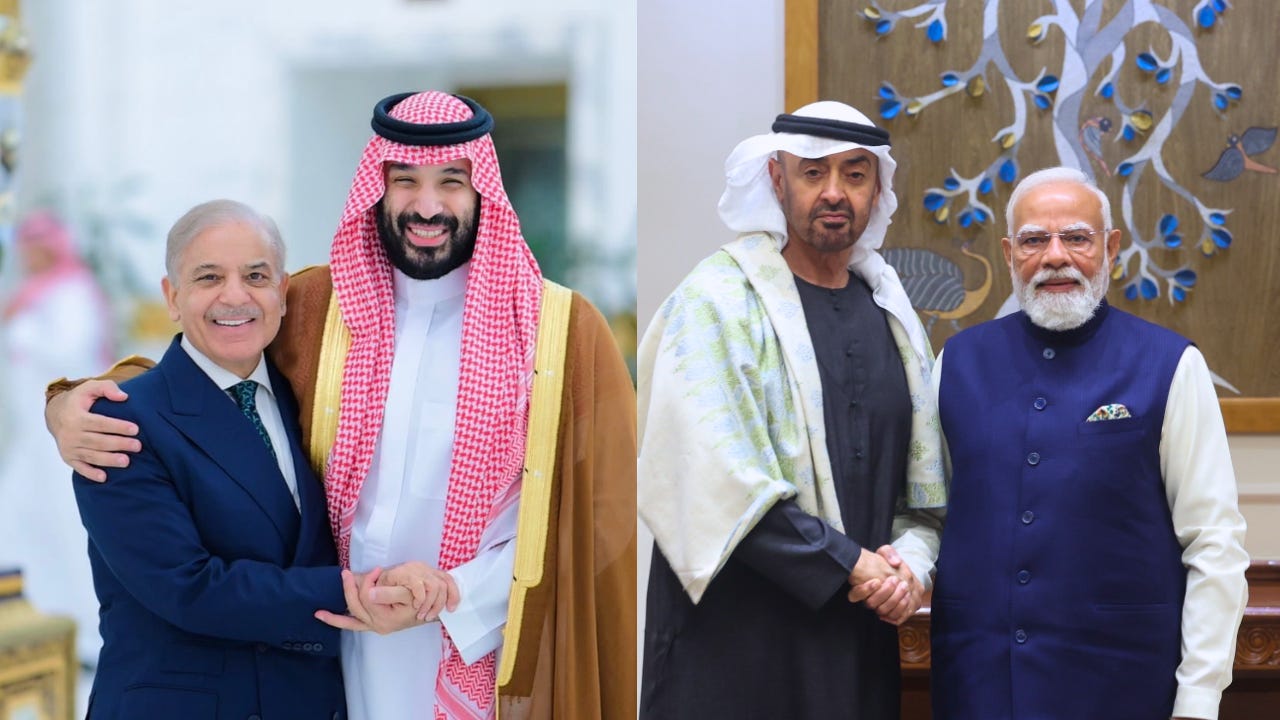
For decades, the friction between India and Pakistan was largely contained within South Asia. Occasionally, it spilled into international forums, and at times its echoes reached the Middle East—though usually confined to cricket fields. That is now changing. In recent months, the Middle East has emerged as a primary arena for this rivalry. At the center of this shift is an informal alignment of four Islamic nations, with Pakistan playing a leading role.
This development stands in contrast to the formal Quad that India had invested significant strategic capital in. The Quadrilateral Security Dialogue—consisting of the United States, Japan, Australia, and India—was born from shared relief efforts after the 2004 Indian Ocean tsunami and eventually formalised to ensure a free and open Indo-Pacific. For New Delhi, it was a golden ticket to a high table where it could balance the rising influence of China. However, Donald Trump’s return to the White House and his administration’s isolationist “America First” stance, along with cooler India–US relations, have left it a largely dormant forum.
Even as the original Quad faded into the background, a new and more assertive formation began to take shape in West Asia. This informal Quad—bringing together Pakistan, Egypt, Turkey, and Saudi Arabia (PETSA)—has evolved from a collection of shared interests into a more coordinated alignment, sometimes described as a “West Asian Quad,” or “Islamic NATO.” Unlike the formal Quad, which has often moved cautiously, PETSA seems to be moving faster on key security and strategic issues. For New Delhi, the irony is hard to miss: this emerging alignment, which places Pakistan at its centre, appears to draw tacit support from the United States, the leader of the original Quad, and China, the very power the Quad was designed to counter.
To understand this shift better, it helps to recall the optimism of the early 2020s. At the time, India was central to a new diplomatic architecture. The Quad was at its peak, holding high-profile summits and moving with a sense of purpose aimed at balancing China’s growing influence. It was in this atmosphere that the I2U2 (India, Israel, the UAE, and the US) also took shape. Often described as a “West Asian Quad,” it complemented the original Quad’s broader strategic outlook. Together, these frameworks reflected India’s attempt to project influence across both the Indo-Pacific and West Asia. But as the political climate in Washington shifted, the momentum behind this approach began to decline.
The emergence of the PETSA grouping can be traced to a series of events that reshaped regional calculations, most notably Operation Sindoor in May 2025. Launched by India in response to a terrorist attack in Pahalgam, the operation marked a shift from strategic restraint to a more assertive doctrine of deterrence. Pakistan, however, used the moment to reposition itself globally, strengthening its ties with the United States while also engaging more closely with major powers in the Muslim world—Turkey with its advanced military industry, Saudi Arabia with its vast capital, and Egypt with its control over the Suez Canal. By projecting itself as a major military power, Pakistan sought to convince these countries that their interests would be better served by working together during a period of regional instability.
A recent development added to Pakistan’s westward shift. The World Bank has moved Pakistan from its South Asia grouping to the Middle East and North Africa (MENA) region for the 2026 fiscal year. While this may seem like a bureaucratic adjustment, it changes how Pakistan’s economy is viewed globally. Instead of being compared with India or Bangladesh, it is now benchmarked against Gulf and North African economies. This suggests that Pakistan is beginning to operate in a different economic space—one increasingly shaped by Gulf investment and West Asian partnerships.
The PETSA alignment is not a simple monolith; it brings together actors that, until recently, had strained relations. Turkey, Saudi Arabia, and Egypt are only gradually moving past years of diplomatic tension. In this context, Pakistan has emerged as a key connecting link, maintaining robust ties with every other actor in the group. More importantly, as tensions around Iran continue to shape the region, Pakistan remains the only member of the grouping with a functional backchannel to Tehran. This unique position makes Islamabad indispensable for the group’s current primary mission: de-escalating the potentially catastrophic Iran-Israel conflict.
Pakistan’s leadership within PETSA is further cemented by its nuclear capability and its deep defense partnership with Riyadh. The Saudi-Pakistan Mutual Defense Agreement (SDMA), signed in late 2025, is a historic “collective security” pact. It contains a NATO-like provision that treats an act of aggression against one as an act against both, effectively making Pakistan the primary security guarantor for the heart of the Middle East—a role once held exclusively by the United States. This alliance provides Saudi Arabia with the “boots on the ground” and a nuclear umbrella it has long desired, while providing Pakistan with the financial lifeblood it needs to sustain its economy.
No country can remain a passive observer to such shifts. With the formal Quad losing momentum, New Delhi has also been trying to expand its western partnerships. The most significant is the Strategic Defence Partnership framework with the United Arab Emirates (UAE). Initiated with a formal signing in early 2026, this partnership has deepened a relationship once centred on oil and Indian labour into one with growing security and strategic dimensions. This has coincided with the UAE’s withdrawal from OPEC in early 2026—a move that signals Abu Dhabi’s willingness to pursue a more independent geopolitical path, rather than align fully with Saudi Arabia. For India, a more autonomous UAE provides an opening to secure long-term energy ties and strengthen its maritime connectivity in the region.
At the heart of India’s competing vision is the India–Middle East–Europe Economic Corridor (IMEC), an infrastructure project linking Indian ports to Europe through the UAE, Saudi Arabia, Jordan, and Israel. It is intended to strengthen trade, connectivity, and supply chains, while offering an alternative to parts of China’s Belt and Road Initiative (BRI). This may encourage regional players to balance their security alignments with Pakistan against their economic partnerships with India.
The inclusion of India in the ‘3+1’ summit with Israel, Greece, and Cyprus is also seen as useful in giving India access as far as the Mediterranean. This adds a secondary strategic axis, particularly with countries that have existing tensions with Turkey. Together, these partnerships reflect a wider network of economic and strategic ties—from the Arabian Sea to the eastern Mediterranean—linked to India’s long-term interests.
For decades, India projected itself as a restrained power and a champion of non-alignment. That position is now being recalibrated, most visibly through its deeper engagement with West Asia, including its strategic relationship with Israel and participation in emerging regional frameworks. Some critics argue this risks diluting India’s standing as a voice of the Global South. But New Delhi appears to be betting on ‘calibrated multi-alignment’ and ‘strategic autonomy’—seeking to balance hard strategic interests with its longstanding global image.
Subscribe to get updates, bookmark, or comment.