

By Sanjay Dubey
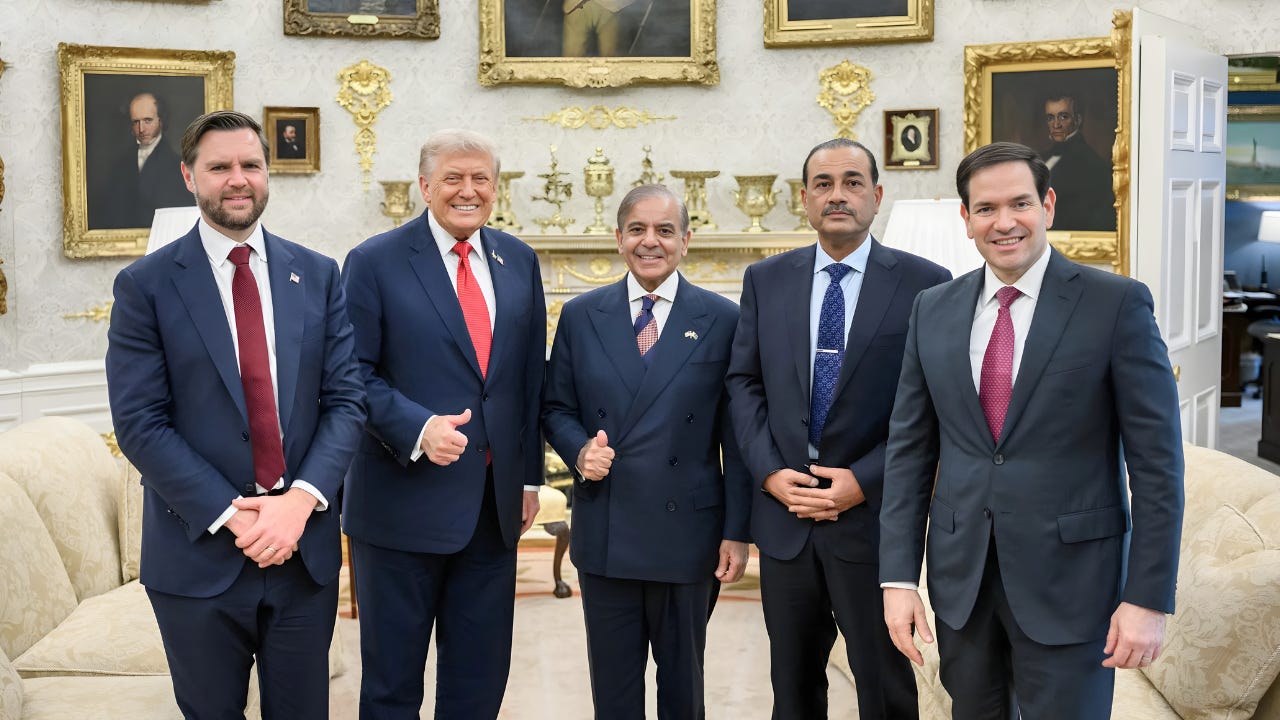
“Based on conversations with Prime Minister Shehbaz Sharif and Field Marshal Asim Munir of Pakistan, and wherein they requested that I hold off the destructive force being sent tonight to Iran… I agree to suspend the bombing and attack of Iran for a period of two weeks. This will be a double-sided CEASEFIRE!”
Donald Trump, the President of the United States, wrote on social media announcing the ceasefire between the US-Israel alliance and Iran.
In an official statement, Iran’s Foreign Minister Seyed Abbas Araghchi, responding to the “brotherly request of PM Sharif”, also declared the ceasefire on behalf of Iran’s Supreme National Security Council. He expressed gratitude and appreciation for his “dear brothers HE Prime Minister of Pakistan Sharif and HE Field Marshal Munir for their tireless efforts to end the war in the region.”
In the volatile weeks following the February 28 US–Israeli strike that killed Iran’s Supreme Leader Ali Khamenei, a quiet but profound role reversal unfolded in South Asian diplomacy. Pakistan—often dismissed as a rogue actor in world affairs—emerged as the most visible mediator in the Middle East crisis. India, with its centuries-old civilisational links to Iran, strong ties with both the US and Israel, non-aligned legacy, membership of the Quad, presidency of BRICS+, and reputation as a principled global voice, found itself largely on the margins—issuing measured calls for restraint while watching Islamabad take the lead in a conflict that affected not just a few countries, but much of the world.
This is remarkable. Until May 2025, when Pakistan fought a four-day war (Operation Sindoor) with India, the country was widely seen as a pariah state. At the time, both Prime Minister Shehbaz Sharif and General Asim Munir were struggling to hold their positions and keep the country together amid deep economic and political crises. But Pakistan’s global standing and Shehbaz Sharif and Asim Munir’s domestic positions improved dramatically after that.
“In mediating between these two parties, Pakistan pulled off one of its most resounding diplomatic victories in years. It is a stunning reversal of fortunes for a country that Mr. Trump once derided as offering ‘nothing but lies and deceit’ and that the Biden administration shunned,” wrote the New York Times, the world’s most influential media outlet, describing Pakistan’s role in the US-Israel-Iran ceasefire.
From India’s point of view, this is more than a one-off event. Some analysts see it as a sign of erosion in the country’s earlier international standing—a shift driven by the steady dilution of a brand that could assert self-interest without appearing selfish. That brand once allowed India to punch above its material weight.
On March 1 — the very next day after the US-Israel strike on Iran — Prime Minister Shehbaz Sharif issued a public statement on X. It offered “the most sincere condolences on the martyrdom” of Khamenei, expressed solidarity with the Iranian people, and explicitly criticised the strike as a “violation of the norms of international law” and the “age-old convention that Heads of State/Government should not be targeted.” It was a careful balance that sounded empathetic and principled, without naming the US or Israel. President Asif Ali Zardari and opposition voices reinforced the message. Within days, Pakistan turned this into concrete action.
By late March, Pakistan was relaying messages between US and Iran. Islamabad convened backchannel summits with Saudi Arabia, Turkey and Egypt, floated practical ceasefire proposals, and positioned itself as the most desired mediator. When the fragile two-week ceasefire took hold on April 7–8, Pakistan was at the centre of attention.
Michael Kugelman of the Atlantic Council calls it “a large feather in the cap” for Pakistan. But he also points to another dimension: “Pakistan has been willing to engage in unconventional diplomatic tactics that score points in Washington — including excessive flattery and commercial opportunities with Trump’s inner circle.” Somewhat similar tactics involving China and Xi Jinping may also have worked in Pakistan’s favour. Trump may also have leaned toward Islamabad for mediation in part because it offered a level of flexibility that is hard to expect from most other countries.
During this period, India’s posture could hardly have been more restrained. The Ministry of External Affairs issued generic statements following the US–Israel strike, urging “restraint, dialogue, and de-escalation,” while placing strong emphasis on protecting the nearly 10 million-strong Indian diaspora in the Gulf and safeguarding energy routes. No high-level condolence message was issued by Prime Minister Narendra Modi or External Affairs Minister S. Jaishankar in the crucial initial days. It was only on March 5—five to six days later—that Foreign Secretary Vikram Misri signed the condolence book at the Iranian Embassy, using carefully neutral language referring to the “demise,” rather than the “martyrdom,” of Iran’s supreme leader, Ali Khamenei.
Opposition leaders—from Congress to regional parties—called the delay an “abdication, not neutrality.” Typically measured voices like Shashi Tharoor noted that, irrespective of condemnation, a timely expression of grief was the bare diplomatic minimum given India’s longstanding ties with Iran.
The messaging gap widened when India strongly condemned Iranian retaliation against Gulf states and Israel and co-sponsored a UNSC resolution targeting Tehran, while remaining silent on the initial assassination’s breach of sovereignty norms and on the deaths of 168 schoolgirls in the US-Israeli strike. Domestic vulnerabilities — energy shocks from the Hormuz closure, remittances from the Gulf, and defence cooperation with the US and Israel — clearly drove the calculus. Yet the optics were unambiguous: a tilt toward transactional partners at the expense of visible solidarity with an old friend and old principles.
What India got wrong
Three interlocking miscalculations might have defined New Delhi’s approach during the Iran war.
First, an apparent over-optimism about Iranian regime fragility. After Khamenei’s death, initial assessments in Delhi (mirroring some Western thinking) seem to have expected the regime to collapse or at least become severely weakened. When the regime instead showed structural resilience, India was forced to change course — requesting safe passage for its ships through the Strait of Hormuz and resuming Iranian oil and LPG imports after a long hiatus. Returning to the “same regime” after early silence only reinforced perceptions of opportunism.
Second, by prioritising only immediate self-interest over broader signalling, India ceded the moral-diplomatic high ground that Pakistan skilfully occupied. Sharif’s Day One statement on norms instantly got Pakistan into Tehran’s good books without burning bridges in Washington. India’s silence on the assassination of Khamenei, by contrast, fed narratives that New Delhi had subordinated principles and old relations to its ties with the US and Israel. Narendra Modi’s visit to Israel exactly before the US-Israel attack also muddied the waters.
Third, the absence of proactive quiet outreach. While Pakistan flooded backchannels with proposals and venue offers, India explicitly ruled out any “go-between” role. No early public or private ideas to improve the situation were floated. The vacuum was filled by Islamabad.
A pattern, not an outlier
This did not emerge in a vacuum. It fits a recurring script of recent years — from Operation Sindoor to India’s deteriorating relations with Bangladesh.
In May 2025’s Operation Sindoor — India’s precision strikes on terror sites in Pakistan/PoJK after the Pahalgam attack — New Delhi emphasised unilateral success and bilateral resolution. Trump claimed he “stopped the war” via trade leverage and mediation. India’s categorical denial of any third-party role irritated Washington. Pakistan, more flexibly, gave the mediation credit and earned Trump’s goodwill. India could have handled this issue more deftly but did not.
During Operation Sindoor we also failed to present our side of the story effectively to the world, the way Pakistan did. While two women military officers — not fully equipped for the job — were left to put forward India’s case in a one-sided manner, and no prominent leader from the ruling administration was visible, Pakistan’s army, its political leaders and its lobbyists in America were doing everything possible on every important forum to present their viewpoint. India tried to rectify this mistake when it sent the all-party parliamentary delegations to different parts of the world. But the damage was already done.
The 2024 Bangladesh crisis is another case in point. While granting refuge to ousted Prime Minister Sheikh Hasina was an unavoidable necessity, India’s subsequent handling — marked by visa refusals, exclusion of Bangladeshi players from the IPL to pander to domestic politics, and the expulsion of the Bangladesh team from the T20 World Cup — escalated a difficult problem into a diplomatic disaster. These actions deeply bruised public sentiment in Bangladesh, isolating India in its own backyard. The optics are particularly jarring as Pakistan and China gain ground in a country that owes its very existence to India.
Even the Trump relationship carried self-inflicted costs. Narendra Modi’s enthusiastic “Abki baar Trump Sarkar” rallies in 2019–20 built personal rapport with Donald Trump, but might not have sat well with Joe Biden. During the 2024 US presidential campaign, Modi maintained a cautious distance from Trump and reportedly did not meet him despite his overtures. When Trump won re-election, the earlier hedging became problematic. This is what happens when a country aligns itself too closely with one political party in another country instead of cultivating bipartisan support.
All this seems to suggest that India is losing the strength that came from its principles, while at the same time not succeeding at the new transactional approach it is now pursuing.
India cannot indulge in what Kugelman describes as the “unconventional diplomatic tactics” of Pakistan. Its historic influence came not only from its size but from its non-aligned tradition — speaking up for sovereignty, standing with anti-colonial causes, and acting as a balancer. That brand made its voice matter far beyond its GDP or military power. But staying silent on big global issues now risks turning India into just another pragmatic deal-maker whose principles look changeable.
The April 10 talks in Islamabad are not yet final. A full US-Iran deal is still not certain. India still has strong cards: good working relations with all three — the US, Israel and Iran; its place in both QUAD and BRICS (India currently has its presidency); and an economy bigger than almost any other country except the superpowers. If India can use these advantages intelligently, it can still have its skin in the game.
India is too big and too important to be sidelined. But what counts the most for a country like India is the courage to speak at the right time without being seen as picking clear sides.
Subscribe to get updates, bookmark, or comment.