

By Sanjay Dubey
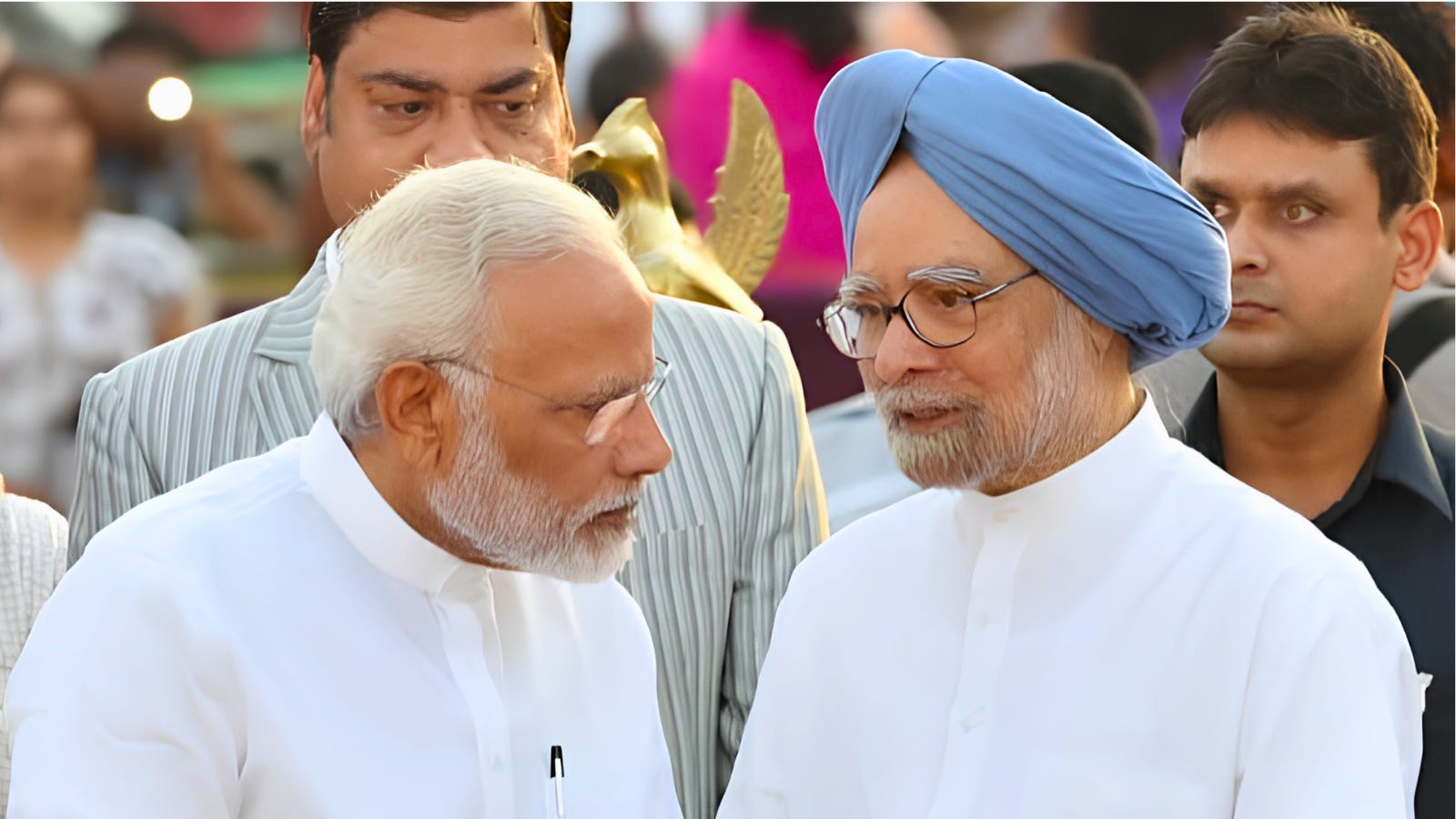
When Narendra Modi swept to power in May 2014, he offered the Indian electorate a compelling promise: clean administration and turbo-charged development. He pledged “minimum government, maximum governance” and championed the business-friendly “Gujarat model”. He asked voters for just five years to alter the nation’s trajectory: “You gave Congress 60 years, give BJP just 60 months. We will change India’s future and bring about development in 60 months”.
For years, public discourse in India has wrestled with how to evaluate his record. Supporters highlight his achievements, while critics point to his failures. But there is one more way to look at it.
“For a long time, the Modi government’s stance on criticism of its performance has been to blame the previous government, specifically the Congress government. In other words, they’ve argued that they were handed a very poor hand, and that much of this poor performance can be blamed on what was handed down to them,” observes Dr. Sumeet Malik, an economist at the University of Amsterdam, in a video analysis.
A research paper, “Promises, Promises: Governance and Growth in India under Modi and the BJP,” by Kevin Grier and Robin Grier of Texas Tech University offers a unique way to test this argument. Instead of measuring India against theoretical benchmarks or just comparing 2023 with 2013, the study asks a deceptively simple question: What might India have looked like if its pre-2014 trajectory had simply continued?
The researchers attempt to answer this by constructing a “Synthetic India”—a statistical version of the country that continues along the path India was on before Narendra Modi took power.
Building a Synthetic India
The creation of Synthetic India began by tracking India’s actual performance over thirty years, from 1984 to 2013. The researchers looked at a range of economic and institutional indicators, including per-capita income and democratic freedoms.
They then selected several donor nations and combined them in carefully calculated proportions. The result was “Synthetic India”, a hybrid country whose economic and institutional indicators closely matched those of real India during the thirty years before Modi came to power (1984–2013).
To model India’s economic trajectory, researchers drew from emerging and developing economies such as China, Brazil, Indonesia, Ethiopia, Pakistan, South Africa, and Mexico, among others.
And for modelling democratic governance, researchers blended developing democracies including Argentina, Chile, Brazil, Mexico, South Africa, Ghana, Peru, and Sri Lanka.
Why use two separate sets of nations for economic and democratic modeling of Synthetic India?
“India is unique in that it has much better political institutions than most countries at its level of economic development. That makes it difficult if not impossible to choose a common donor pool for the economic and political outcomes we study,” explain Grier and Grier in their study. (A few nations, such as Brazil, Mexico, and South Africa, were included in both pools).
The researchers then compared the path real India took between 2014 and 2023 against the trajectory of this synthetic benchmark. Because Synthetic India matched real India so closely for three full decades before 2014, the researchers argue that the major differences between them after 2014 can be attributed to the change in government.
There is an interesting dimension here. The period used to construct Synthetic India runs from 1984 to 2013, and the final ten years of that stretch were the Manmohan Singh years—the longest uninterrupted tenure by any prime minister in that window. So while the study doesn’t literally state what a Manmohan Singh government would have delivered had it been re-elected in 2014, Synthetic India inherently reflects his government's path.
Now, back to our thread, the comparison between real India and its synthetic twin produced striking results. Across ten years and eleven economic and governance metrics, the study found that India didn’t just fail to beat Synthetic India—it underperformed it substantially.
A decade of democratic decline
On the governance front, the researchers examined ten measures from the Varieties of Democracy (V-Dem) institute’s dataset covering polyarchy (electoral health), liberal democracy, political corruption, equality before the law, freedom of association, freedom of expression, freedom of religion, equal protection, and institutional checks on executive power by both Parliament and the judiciary.
Grier and Grier compared these ten governance measures of real India with Synthetic India every year from 2014 to 2023 — 100 comparisons in all. In 96 of those 100 comparisons, India performed worse than its synthetic counterpart.
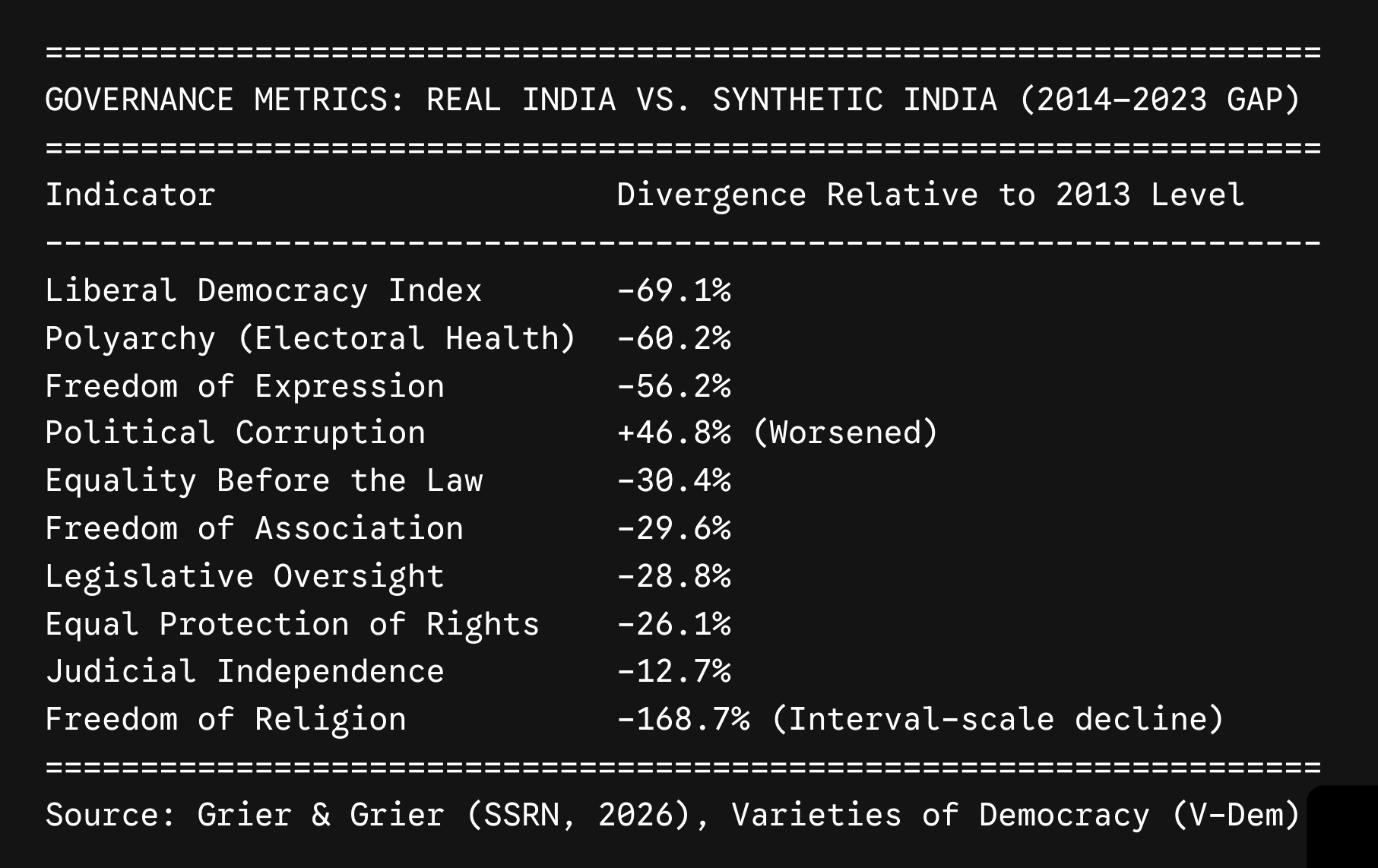
By the last year, India’s score on polyarchy was about 60 percent lower than the synthetic path. Liberal democracy was about 69 percent lower. Freedom of religion showed the steepest deterioration. Political corruption was nearly 47 percent higher than the synthetic path, compared with its 2013 level. Equality before the law, freedom of association, and equal protection also ended well below their synthetic counterparts.
The paper notes that these gaps did not appear because the donor countries used to construct Synthetic India suddenly improved. Synthetic India remained relatively steady while India’s institutional scores moved sharply downward.
Missing the ‘Gujarat Model’
Political scientists often discuss the “strongman bargain”—an arrangement in which citizens accept weaker democratic institutions if a leader delivers exceptional economic prosperity.
The study suggests that India did not achieve that bargain either.
Rather than outpacing “business as usual,” India’s real per-capita GDP fell behind its synthetic twin almost immediately after 2014.
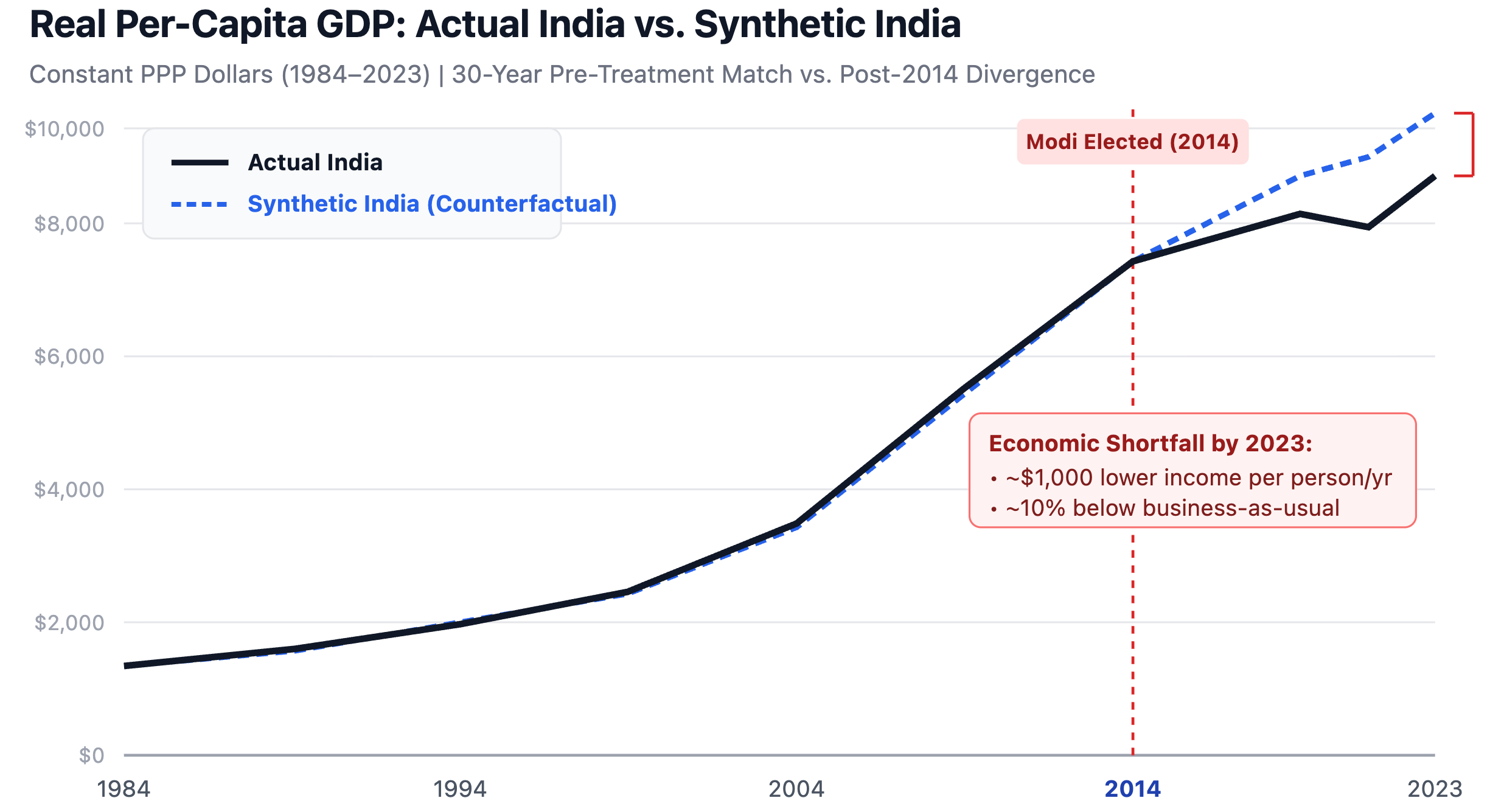
By the end of 2023, India’s real per-capita GDP was roughly 10 percent lower than its counterfactual. In real terms, this translated into an annual shortfall of more than $1,000 per person.
The researchers also examined whether major disruptions such as the 2016 demonetisation and the COVID-19 pandemic distorted the results.
They argue that demonetisation was an intentional policy decision of the Modi government and should therefore be counted as part of the administration’s performance.
And the COVID-19 pandemic was a global shock that affected India as well the donor countries used to construct Synthetic India.
There is also a long-running debate over India’s GDP measurement after the 2015 revision to national accounts methodology. Critics argue that the revised methodology overstated subsequent growth. The authors note that if those critics are right, their estimate of India’s economic shortfall is conservative—meaning the actual gap could be even larger.
Studies like this depend on how comparison countries are selected and how closely Synthetic India matches real India before 2014. The researchers acknowledge this, but note that their 30-year pre-2014 matching period provides an unusually long baseline.
They also conducted a placebo test to ensure the model was not producing arbitrary divergence. When they instructed the model to assume that Modi took office in 2001 instead of 2014, actual India and Synthetic India still tracked each other closely through 2013. The divergence occurred only after the real political transition in 2014.
This does not mean every development after 2014 was caused solely by Modi, nor does it serve as a defense of earlier governments. It also does not measure India against an impossible standard. Rather, it compares India with what its own past trajectory and the experience of comparable developing nations suggest was achievable.
That said, the study is not beyond question. As Dr. Malik notes in his YouTube video:
“I know some of you will disagree with the study, and that’s perfectly fine... Go ahead, read it. Critique the assumptions. Critique the method. This is exactly what we should do with the research. But there is a difference between questioning evidence and refusing to look at evidence because we do not like where it leads us.”
Subscribe to get updates, bookmark, or comment.