

By Sanjay Dubey
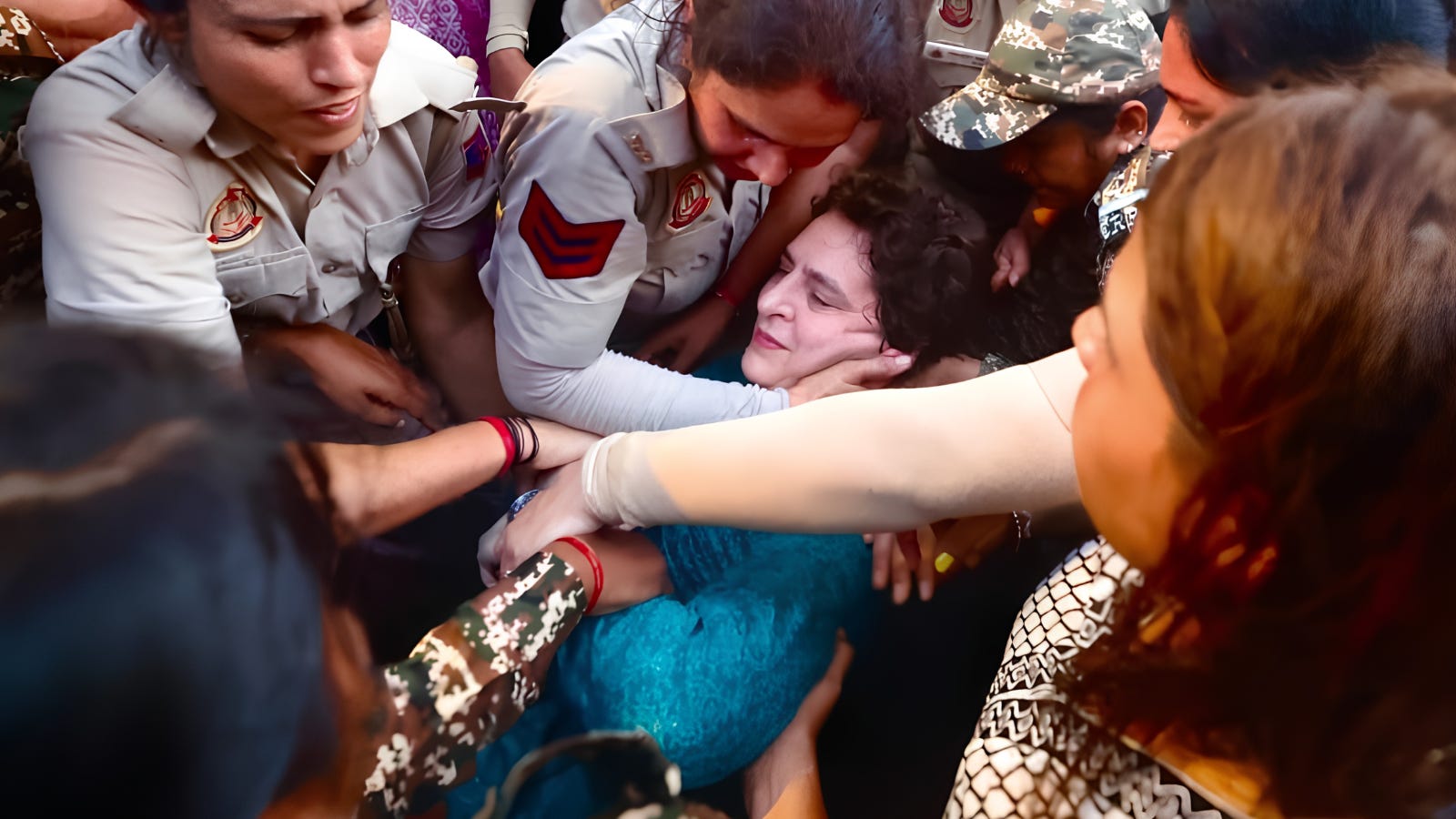
One thing can easily be said about the protests taking place in Delhi against the Election Commission and Chief Election Commissioner Gyanesh Kumar: they are peaceful. People are raising slogans, carrying posters and asking questions. There is no violence, stone-pelting or vandalism that might justify preventing protesters from demonstrating at a place meant precisely for that purpose. Yet they are not being allowed anywhere near Jantar Mantar, let alone permitted to protest there.
Delhi Police detained hundreds of people on October 2. It did the same on October 3. Then, on October 6 and 7, the same happened to Leader of the Opposition Rahul Gandhi, Priyanka Gandhi and a large number of opposition MPs. Anyone who resisted, including Rahul Gandhi and Priyanka Gandhi, was met with Delhi Police’s familiar use of force. Despite this, the protests remained largely non-violent. And yet, short of calling in the army, almost every measure is being taken to prevent them from continuing.
This raises a very simple question: why are questions being asked of the Election Commission being answered through the police?
The police cannot explain why two members of the Election Commission repeatedly recorded written objections to the Commission’s decisions. It cannot explain who changed Form 6, which is used to give people the right to vote by adding them to the electoral roll, or what consequences that change might have. The police cannot explain why, after judicial officers in West Bengal decided that the names of lakhs of voters should remain on the electoral rolls, the Commission seems determined to have those decisions overturned. Nor can it explain why names are increasingly being added to electoral rolls only through Delhi when, under the law, this is the job of EROs spread across the country. Or why the three members of the Election Commission no longer seem to meet and take decisions together. And how can the police explain what forced, for the first time in the Commission’s history, two Election Commissioners to write to the Cabinet Secretary about the disorder within their own institution?
Only the Election Commission can answer these questions—not the police or the central security forces, and not the Modi government. Yet the questions being raised about the Commission are receiving mostly political answers. Sometimes BJP spokespersons answer them, sometimes BJP chief ministers in different states. The Election Commission alone remains silent. And when people protest against that silence, Delhi Police answers them in its own way.
The Modi government, too, has to answer several important questions related to this matter. But for now it seems busy turning central Delhi into a fortress in order to protect the Election Commission’s freedom not to speak.
The questions facing the Election Commission are not merely political questions invented by Rahul Gandhi, Priyanka Gandhi or the opposition. In September 2026, an Indian Express investigation appeared whose basic findings the Election Commission itself did not deny. It showed that two members of the three-member Commission—Sukhbir Singh Sandhu and Vivek Joshi—had themselves raised several of these questions in writing.
According to The Indian Express, between November 2025 and September 2026 the two Commissioners recorded written objections at least 14 times to important decisions and procedures of the Election Commission. One of these concerned Form 6, through which new voters are added to the electoral rolls. Recently, the form was modified to ask whether the applicant or the applicant’s parents had been included in the previous SIR. According to Commissioners Sukhbir Singh Sandhu and Vivek Joshi, doing this was “illegal” and “unauthorised” because the Election Commission could not change Form 6 in this manner on its own; a prescribed legal procedure had to be followed.
Later, when the Election Commission said in a press release that the new Form 6 had also been approved by the Supreme Court, Chief Justice of India Surya Kant said in open court that the Supreme Court had approved no such modified Form 6.
The Indian Express report also said that in Goa, after 97 people received Election Commission notices, the concerned EROs heard their cases, examined their documents and found them eligible to be included in the electoral roll. The law gives the ERO—usually an SDM—the authority to decide such matters. But the Election Commission’s new website, ECINet, did not allow the officials to add these 97 names. The officials repeatedly wrote to the Election Commission in Delhi, but nothing happened. As a result, all 97 voters were left out of Goa’s final electoral roll. According to the latest information, they are now trying to get their names added through Form 6.
It was incidents like these that led both Election Commissioners to separately record their concern that control over electoral rolls was increasingly shifting away from EROs spread across the country and into the hands of a few people sitting in Delhi. According to them, this was not only contrary to the statutory arrangement, it could also create room for large-scale manipulation of electoral rolls.
During the SIR in West Bengal, around 60 lakh people were issued notices for “logical discrepancies”. Judicial officers were assigned to examine these cases. Tribunals headed by retired High Court judges were created to hear appeals against their decisions. Among the appeals that reached these tribunals were around 16 lakh challenges against people whom the judicial officers had decided should remain on the electoral rolls. According to the Express, Election Commissioner Sandhu wrote to Commission officials in August 2026 asking on whose instructions these appeals had been filed on behalf of the Election Commission.
What is remarkable is that, during a Supreme Court hearing, the Commission told the Court that there were a total of 38 lakh West Bengal-related cases before the tribunals—but not that 16 lakh of those cases had been filed by the Commission itself seeking to remove people from the rolls.
One broad inference from this is that the Commission tried to mislead the Court. Another is that an institution that traditionally emphasised adding eligible citizens to the electoral rolls has, in recent times, begun to appear more focused on deleting names and making registration more difficult. And decisions do not appear to be taken collectively either. Otherwise, two Election Commissioners would not have had to repeatedly record their objections and dissent in writing. The Indian Express report also says that for nearly four months there was no joint meeting of all three Election Commissioners.
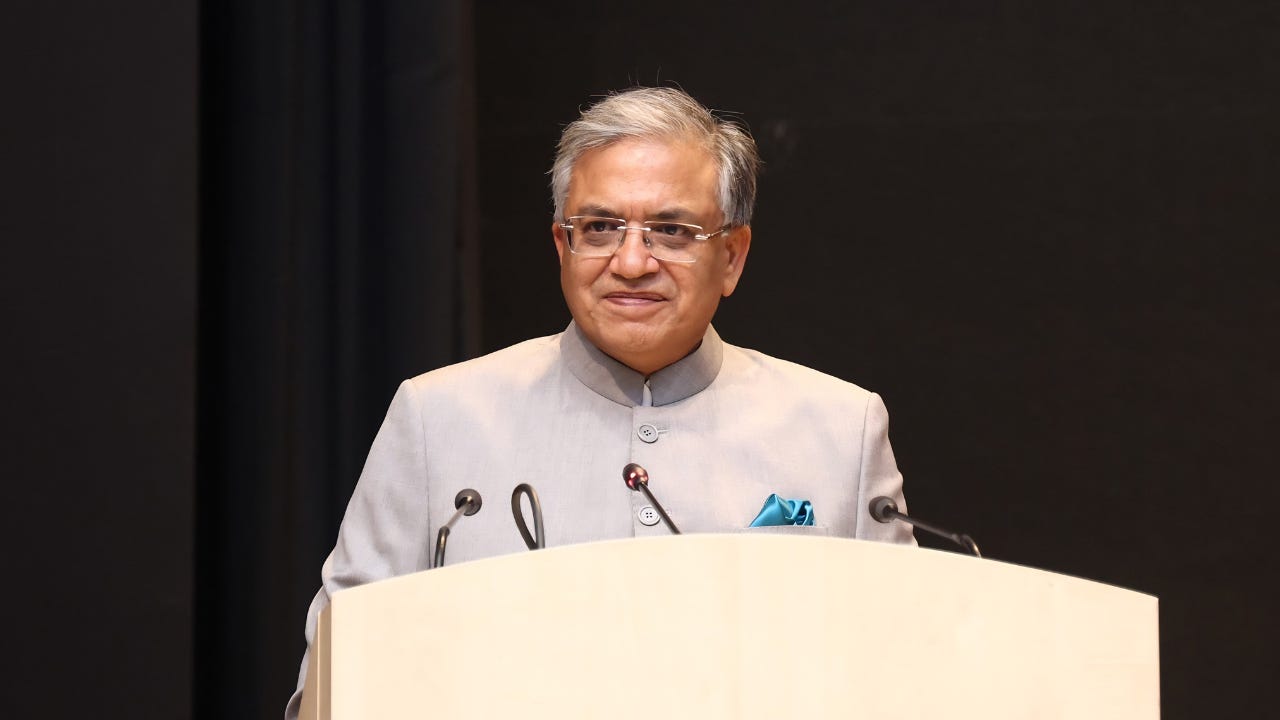
The law says the Commission’s business should, as far as possible, be conducted unanimously, and where there is disagreement, the decision should be taken by majority. But if that were happening, the extraordinary event that occurred for the first time in the Election Commission’s history would not have happened. Sandhu and Joshi separately wrote two letters to the country’s Cabinet Secretary, citing violations of rules within the Commission. The Election Commission later said only that these letters concerned the functioning of one official. But if two members of an independent constitutional body have to approach the Cabinet Secretary merely to complain about one official, the matter stops looking quite so simple.
To understand the seriousness of this, it is worth recalling the Supreme Court’s 1995 judgment on T.N. Seshan’s petition challenging the Narasimha Rao government’s decision to make the Election Commission a three-member body. The Supreme Court dismissed that petition.
The essence of that judgment was very clear: the Election Commission is not merely the Chief Election Commissioner. All three Commissioners together constitute the Election Commission. The Chief Election Commissioner is its chairman, not the master of the other two members.
But the present Election Commission does not appear to behave that way.
After The Indian Express report appeared, the Election Commission issued two rather evasive press releases. They do not deny the allegations contained in the report, but neither do they answer its fundamental questions.
Now to the Modi government’s role in this affair, and the questions that can be asked of it.
Article 324 of the Constitution gives the Election Commission extraordinary powers. But it does not prescribe a specific method for selecting Election Commissioners. It leaves the appointment of the Chief Election Commissioner and other Election Commissioners to the President, acting on the aid and advice of the Union government, “subject to the provisions of any law made in that behalf by Parliament”.
But Parliament did not make such a law for more than seven decades. The Union government continued to decide the names of Election Commissioners, and the President appointed them.
In March 2023, a five-judge Constitution Bench of the Supreme Court filled this vacuum. In the Anoop Baranwal case, it said that the Election Commission had to be insulated from executive influence if elections were to remain free and fair. Until Parliament enacted a law, it put in place an interim arrangement under which all Election Commissioners would be selected by a committee consisting of the Prime Minister, the Leader of the Opposition in the Lok Sabha and the Chief Justice of India.
For the first time, this created a selection process in which the government could not appoint Election Commissioners entirely on its own. A few months later, in December 2023, the Modi government replaced it with a new law governing the appointment of Election Commissioners—the Chief Election Commissioner and Other Election Commissioners Act, 2023.
The new law removed the Chief Justice of India from the selection committee. In his place, it put a Union Cabinet minister chosen by the Prime Minister. In the three-member committee, the Prime Minister and a minister chosen by him now sit on one side, and the Leader of the Opposition on the other. In plain terms, this means the government can once again choose whichever Election Commissioner it wants, provided the person holds or has held a post equivalent to the rank of Secretary to the Government of India.
Section 16 of the law also gives serving and former Election Commissioners very broad personal legal protection for their official or purportedly official acts. In other words, no civil or criminal proceedings can be instituted against them in a court for such acts, although judicial review of the Commission’s decisions is not excluded.
These changes raise several questions. And it is not only the opposition that has raised them. In September 2026, two Supreme Court judges—Justice Dipankar Datta and Justice S.C. Sharma—reached different conclusions on petitions challenging the 2023 Election Commissioners law. The matter will now go before the Chief Justice of India, who will decide the appropriate bench to hear it. In his judgment, Justice Datta said that it was not enough for the Election Commission to be independent; it must also appear to be independent. He also questioned whether a Cabinet minister on the selection committee could truly be regarded as independent of the Prime Minister, saying that in such a situation the presence of the Leader of the Opposition could become merely ornamental.
The question, then, is this: why did the Modi government use legislation to dismantle a Supreme Court-created arrangement for selecting Election Commissioners that at least appeared independent? It is one thing to continue with an old system that carries the possibility of misuse. It is quite another to move away from a better system after it has been put in place and return to the old path. That naturally creates suspicion.
A good system is not one that works well when good people are in power. A good system is one that even bad people cannot easily misuse. It should not depend on the virtues or vices of those in office.
The Modi government’s new law and the arrangement created under it do not appear to pass these tests. The appointment system that may suit the BJP today could tomorrow be in the hands of another party’s government and be used against it.
In 2024, Gyanesh Kumar and Sukhbir Singh Sandhu became the first Election Commissioners chosen under this new law. And the manner in which they were selected places the Modi government under another set of questions.
The Election Commissioners Act received presidential assent at the end of December 2023, just a few months before the 2024 Lok Sabha election. Soon afterwards, Congress leader Jaya Thakur—and later the ADR—approached the Supreme Court against it. Then, on March 9, 2024, just days before the general election schedule was to be announced, Election Commissioner Arun Goel suddenly resigned. Had he not resigned, he would today have been the Chief Election Commissioner instead of Gyanesh Kumar and would have remained in office until the end of 2027.
After Goel resigned, only one member remained in the Election Commission—Chief Election Commissioner Rajiv Kumar—because the other Election Commissioner, Anup Chandra Pandey, had retired in February 2024. Fearing that the government would now appoint both Commissioners under the new law even though a challenge to it was pending before the Supreme Court, Jaya Thakur and the ADR sought an urgent hearing. They wanted the new appointment law stayed. On March 13, a Bench headed by Justice Sanjiv Khanna agreed to hear the matter on March 15. But the very next day, the government hurriedly appointed Gyanesh Kumar and S.S. Sandhu as Election Commissioners.
They were the first Election Commissioners chosen under the new law. The selection committee consisted of Prime Minister Narendra Modi, Home Minister Amit Shah and Adhir Ranjan Chowdhury, then the leader of the largest opposition party in the Lok Sabha. Chowdhury said the final six names were given to him only minutes before the selection meeting, making it impossible for him to seriously examine them.
When Gyanesh Kumar became Chief Election Commissioner, Rahul Gandhi was Leader of the Opposition in the Lok Sabha. He too opposed Kumar’s appointment because a Supreme Court hearing on the composition of the selection committee was due shortly afterwards. He argued that the appointment should be deferred until then. It was not.
Arun Goel’s own appointment was no less interesting. In November 2022, while the Supreme Court was hearing the Baranwal case on creating an independent process for appointing Election Commissioners, Goel’s voluntary retirement was approved in a flash and, just as swiftly, the Modi government appointed him Election Commissioner. The Supreme Court appeared sharply displeased by the manner of the appointment and asked the Modi government some very pointed questions.
The timing itself raised questions about the Modi government’s intentions. Otherwise, why was there such urgency to make the appointment while the Supreme Court was in the middle of hearings on precisely this issue? Appointments to positions this important should, in any case, require considerable thought. Yet the government did something very similar when appointing Gyanesh Kumar and Sukhbir Singh Sandhu.
The official reason for Goel’s resignation remains unclear. But a Hindustan Times report says that he and CEC Rajiv Kumar had differences on several issues. One of them concerned the Shiv Sena split. When deciding whether the party name and symbol should go to the Shinde or Thackeray faction, Goel wanted organisational majority to be given weight as well. The final decision, however, was unanimous, and the party name and symbol went to the Shinde-led faction, which had more MLAs and MPs and was allied with the BJP in Maharashtra.
Whatever the reason, there can hardly be a more important responsibility for an Election Commissioner than managing a Lok Sabha election. During Goel’s tenure, that opportunity would have come only once—in 2024. Yet just before it, and only about a year before he was due to become Chief Election Commissioner, he left the field.
It did not cost him very much. A few months later, he was appointed India’s ambassador to Croatia.
The Modi government is the only government in the country under which two Election Commissioners resigned who, had they not done so, would later have become Chief Election Commissioners.
Before Goel, the Election Commissioner who did this was Ashok Lavasa in 2020. Before that, it had happened only once, in 1973, when then Chief Election Commissioner Nagendra Singh resigned. But he did not leave amid any controversy; he resigned because he had been appointed to the International Court of Justice.
Ashok Lavasa had been appointed Election Commissioner by the Modi government in the normal manner under the previous appointment process. But he did not get along with then Chief Election Commissioner Sunil Arora.
During the 2019 election, five complaints concerning alleged violations of the Model Code of Conduct by Narendra Modi and Amit Shah came before the Election Commission. Arora and the third Election Commissioner gave Modi and Shah clean chits in those cases. Lavasa disagreed. He wanted his minority opinion to be included in the Commission’s final orders. The Commission rejected his demand 2-1. Lavasa then recused himself from meetings relating to Model Code complaints.
A few months after the election, reports emerged of Income Tax investigations and notices involving his wife, son and sister. Some time later, Lavasa resigned from the Election Commission and moved to the Asian Development Bank. His departure cleared the way for Rajiv Kumar to eventually become Chief Election Commissioner.
After Gyanesh Kumar, Rajiv Kumar was perhaps the other Chief Election Commissioner to have attracted the most controversy. But before turning to him, it is worth looking a little more closely at the tenure of Sunil Arora, about whom Yogendra Yadav wrote in The Indian Express that with his appointment in December 2018, the Election Commission entered the present phase of decline in institutional autonomy and political neutrality.
After the Lavasa episode, Arora became embroiled in another major controversy during the 2021 West Bengal election. The Commission conducted polling there in eight phases. Critics alleged that such a prolonged schedule benefited the BJP because it allowed the Prime Minister and other national leaders to hold more campaign rallies in the state. The Commission argued that the schedule was necessary because of violence, the availability of security forces, the large number of polling stations and Covid. But it was unusual enough for questions about the Election Commission’s neutrality to arise naturally.
This is not to suggest that the Election Commission was never at the centre of controversy before the Modi government.
In 1989, just weeks before the general election, the Rajiv Gandhi government appointed two additional Election Commissioners for the first time. It created a major controversy. It was alleged that the appointments were intended to reduce the influence of then Chief Election Commissioner R.V.S. Peri Sastri because his relationship with the government had become strained.
The following year, the V.P. Singh government abolished both posts. One of the Election Commissioners, S.S. Dhanoa, went to court against the decision. He alleged that the new government was hostile to him, particularly because of a dispute over the Janata Dal’s election symbol during the 1989 election. The Supreme Court dismissed his petition.
In 1991, the Chandrashekhar government enacted a law governing the service conditions of the Chief Election Commissioner and other Election Commissioners—the Election Commission (Conditions of Service of Election Commissioners and Transaction of Business) Act, 1991.
Then in 1993, amid an open confrontation with T.N. Seshan, the P.V. Narasimha Rao government once again made the Commission a three-member body. At the same time, the 1991 law was amended to clarify that the Commission would try to decide matters unanimously and, where there was disagreement, decisions would be taken by majority. Seshan challenged this in the Supreme Court. But in 1995 the Court upheld both the multi-member Commission and the system of majority decision-making.
Despite these and a few other controversies, until fairly recent years the Election Commission remained a source of pride for Indian democracy around the world. Other countries learnt from it; Indians took pride in it. If that is no longer the case, a great deal of responsibility lies with Rajiv Kumar, who succeeded Sunil Arora, was chosen by the Modi government and became Chief Election Commissioner after Ashok Lavasa’s resignation cleared his path.
If Sunil Arora’s tenure saw the resignation of one Election Commissioner and only a handful of major controversies, Rajiv Kumar matched him on the first count and went miles ahead on the second.
It was during Rajiv Kumar’s tenure that a new practice began of sending notices to the presidents of political parties instead of directly to senior leaders such as Prime Minister Narendra Modi over alleged Model Code violations. It was also during his tenure that a major controversy erupted over voter-turnout figures, eventually reaching the Supreme Court.
It was under Rajiv Kumar that the Shiv Sena and NCP splits reached the Election Commission, and in both cases the Commission awarded the original party name and symbol to factions that were in power with the BJP.
It was during Rajiv Kumar’s tenure that the controversial delimitation of Assam took place. Assam Chief Minister Himanta Biswa Sarma himself later said that, because of the delimitation, Muslim voters remained decisive in only around 23 seats. The obvious beneficiary was the BJP.
The unusual Surat election during the 2024 Lok Sabha polls also took place under Rajiv Kumar, when the BJP candidate was elected unopposed without a single vote being cast. An investigation by The Guardian reported allegations by several candidates of pressure and threats. According to the report, the Election Commission took no action on complaints made to it in the matter.
A 2024 Indian Express investigation found that since 2014, 25 prominent opposition leaders facing action by central investigative agencies had joined the BJP, and 23 of them later received relief of one kind or another—three cases were closed and action in 20 others stalled or went cold. The newspaper also noted that allegations of political misuse of central agencies had existed during the UPA years as well, but on a much smaller scale.
Just before the 2024 Lok Sabha election, the Income Tax Department froze the Congress party’s main bank accounts over a tax dispute. The Congress accused the Modi government of political vendetta, while the BJP and the Income Tax Department described it as routine legal action.
Whatever the motive, restricting the main opposition party’s access to its electoral resources immediately before an election raised serious questions in itself. If it was merely a routine legal action, could it not have been taken six months earlier or two months later?
None of these events proves that the Election Commission is in collusion with the government. But if someone looks at all of them together and raises questions about the conduct of the present Election Commission and Gyanesh Kumar, how can they simply be dismissed on the ground that they possess no conclusive proof?
If someone questions the Election Commission’s decision to conduct an SIR in Bihar just before the Assembly election, during the flood season and when a large part of the state’s migrant population was away in search of work, how can that person simply be called wrong?
Similar questions can be asked about the SIR in West Bengal. It was carried out just before the Assembly election. In such circumstances, if errors occur, the scope for correcting them fully before polling is very limited—and that is what happened. If someone therefore questions the motives of the Commission that chose to conduct the SIR at that time, how can that be called wrong?
Why could the Bihar SIR not have been held at some other time? Why could the West Bengal exercise not have been carried out last year, when Bihar’s was done and when the Bengal election was still some distance away? Why was it so necessary to conduct SIRs in both states immediately before elections?
When the BJP alone does not ask the Election Commission such questions, but instead begins answering questions that are being asked of the Election Commission, questions about the BJP’s role are only natural.
It is hardly a secret that the BJP tries to form its governments at almost any cost. Beyond that, the Modi government dismantles a sound arrangement created by the Supreme Court for selecting Election Commissioners and replaces it with one that is under its own control. It then places in the Election Commission senior bureaucrats it has known, watched and worked with for years. When serious allegations are raised against them, it vigorously defends them. And when citizens protest against them, they find themselves facing the Delhi Police and central security forces controlled by the same Union government.
Does all this strengthen our trust in the Election Commission—or weaken it?
Should these questions not be asked?
Subscribe to get updates, bookmark, or comment.