

By Sanjay Dubey
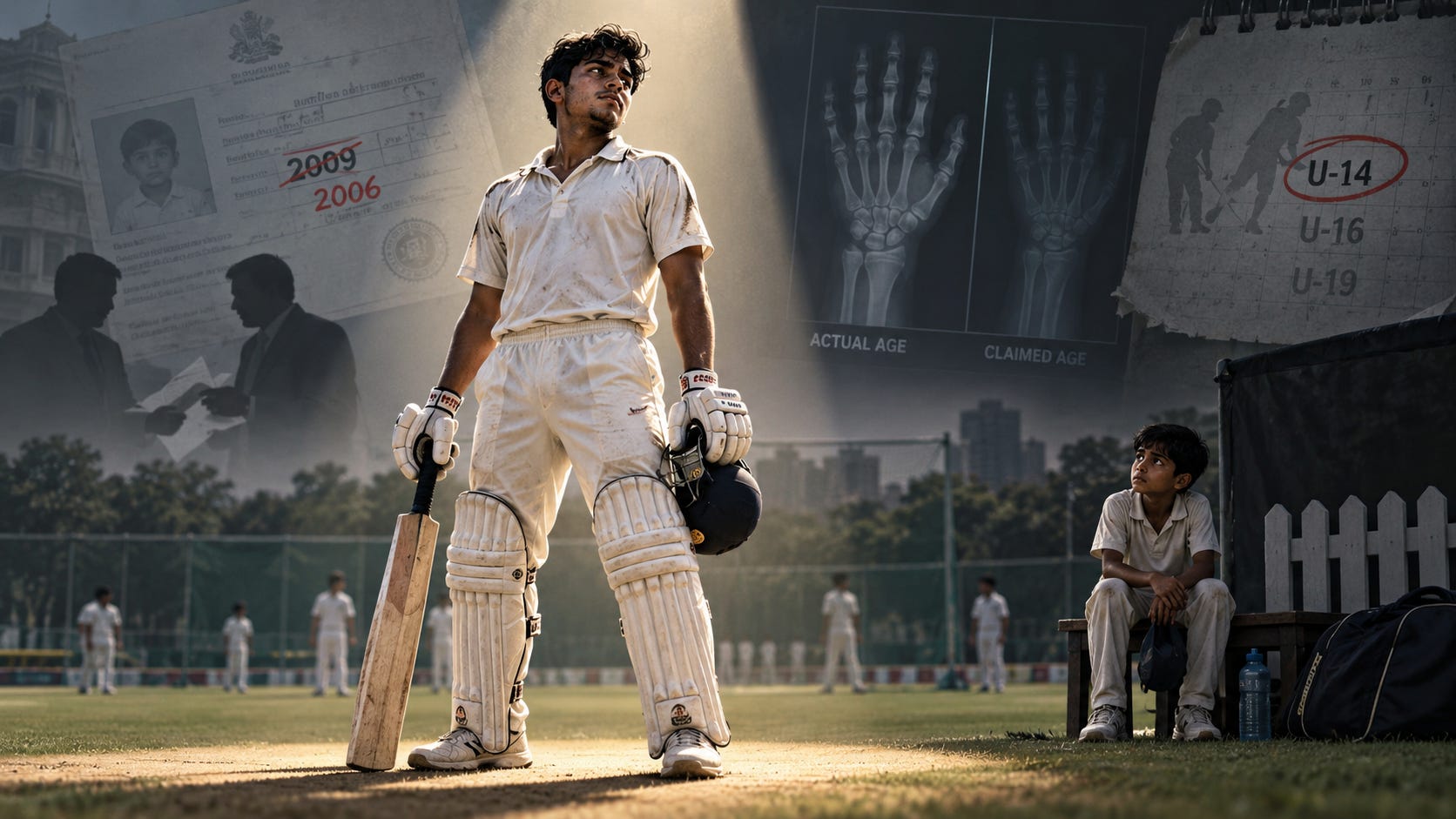
Age fraud has plagued Indian sports, particularly cricket, for decades. The issue keeps resurfacing, raising serious questions about the integrity of the game and the future of young athletes.
In November 2024, six Hyderabad players, including the designated captain of the Under-19 state team, were banned by the Board of Control for Cricket in India (BCCI) for age falsification. The players had been selected to represent the state in the Vinoo Mankad Trophy, a prestigious national Under-19 tournament. The fraud came to light after complaints from parents.
Women’s cricket has faced similar problems. In December 2022, just weeks before the inaugural Women’s Under-15 One-Day Tournament, 14 of Karnataka’s 25 probable players failed the age-verification test. Such cases, surfacing at regular intervals, show how deeply entrenched the problem is across genders and age groups.
Age fraud usually involves falsifying official documents such as birth certificates, school records or affidavits to make players appear younger than they actually are. The advantages of manipulating age can include extending eligibility for age-restricted competitions, gaining a competitive advantage over younger opponents, securing scholarships, government jobs and reserved seats in educational institutions, and even setting new national records.
Sports such as football, badminton and athletics have also been significantly affected by age falsification. In many sports, the practice has become so normalised that people engage in it brazenly, with little hesitation.
For instance, in badminton, India’s second-most popular sport, a 2019 petition filed in the Karnataka High Court revealed that several Indian shuttlers, including some top players, had no hospital records to verify their birth certificates. Many claimed to have been born at home, while some offered explanations that were difficult to believe. In one case, a player’s father said that his child had been born in an auto-rickshaw on the way to hospital.
A parent of a junior badminton player highlighted the scale of the problem in an Outlook report, describing age-category tournaments as being “so adulterated by age fraud that they are like milk with 80 percent water.”
A striking example from athletics came at the 2019 National Inter-District Junior Athletics Meet (NIDJAM) in Tirupati, where 51 athletes were found to be overage and another 169 skipped the verification process altogether.
Over the past decade and a half, several initiatives have been introduced to address the problem. The National Code Against Age Fraud in Sports (NCAAFS), introduced in 2010, mandates age verification through various tests. However, its impact has been limited, partly because it does not prescribe penalties for falsifying age documents. Another problem is the lack of proper records maintained by the Ministry of Youth Affairs and Sports, making it difficult to identify and track habitual offenders.
To address this gap, the government introduced the National Sports Ethics Commission Bill, 2016, which proposed criminal penalties for age fraud and related offences. However, the bill remains pending in Parliament, with no clear timeline for discussion.
The Central Bureau of Investigation (CBI) also established a Sports Integrity Unit in 2014 to address corruption in sports. While the unit can recommend action against offenders, it does not have the authority to impose penalties itself.
The BCCI has also taken steps to tackle age fraud. In 2012, it introduced the Tanner-Whitehouse 3 (TW3) method to determine an athlete’s age. The method is considered more accurate than the previously used Greulich and Pyle (GP) method, with a margin of error of around six months compared with roughly two years for GP.
However, significant challenges remain. The TW3 method cannot be applied reliably to players older than 16, making it ineffective for verifying players who enter the system at the Under-19 or Under-23 levels. The test can also disadvantage athletes whose naturally higher bone density may make them appear older than they actually are.
P.S.M. Chandran, former director of sports sciences at the Sports Authority of India, points to another problem arising from an over-reliance on bone-age tests. In an article published in The Wire, he argues that instead of strictly verifying documents, sports organisations rely on costly yet inconclusive age tests, partly because the entire testing process creates financial opportunities for those involved in it.
Rahul Dravid, former head coach and captain of the Indian cricket team, has been one of the most vocal critics of age fraud. In one of his lectures, he described the “scourge of overage players in junior cricket” as being no different from “fixing and corruption.” Dravid argues that prioritising short-term results not only undermines fairness but also sets a dangerous precedent by teaching young players that dishonesty is acceptable in the pursuit of success.
As Dravid explained, the consequences of age fraud are both far-reaching and deeply damaging. It undermines the integrity of the game, deprives deserving players of opportunities and creates an unhealthy environment in which winning at any cost becomes acceptable. For those who commit the fraud, being caught can result in bans, public humiliation and career setbacks. Meanwhile, honest players can face marginalisation, disillusionment and, in some cases, an early exit from the sport.
It is also important to recognise that responsibility for age fraud does not necessarily lie with the players themselves. In many cases, the manipulation happens when they are very young, leaving them unaware of what is being done or of its possible consequences. Experts believe that parents, coaches and officials often play a much bigger role in perpetuating the problem. At times, even parents may be unaware of the legal consequences of their actions.
In some cases, age falsification happens for reasons unrelated to gaining an advantage in sport. Particularly in the case of girls, reducing their recorded age by a few years has been a common practice in some small towns. “The intention isn’t to provide a sporting advantage but rather to give parents more time to make suitable marriage arrangements for their daughters,” says Dharmendra Singh, a cricket enthusiast from Agra.
The lack of strict action by authorities is also seen as one of the major reasons age manipulation remains so widespread in sports. Critics point, for instance, to the 2019 relaxation of age-fraud rules by the BCCI, which allowed banned players to participate in inter-club matches during the period of their ban.
Similarly, in 2020, the BCCI introduced a Voluntary Disclosure Scheme, allowing players to avoid suspension if they voluntarily admitted to falsifying their birth records.
This is also a larger question: when there is no criminal liability for a sportsperson found to have deliberately falsified their age, how effectively can age fraud in sports be discouraged?
Aahna Mehrotra, author of Law and Sports in India, advocates criminal punishment for those involved in age fraud. But she also stresses that such laws should take into account factors such as the athlete’s age at the time the fraud was committed — with lighter penalties where the athlete was a minor — as well as the extent of the discrepancy between the real age and the falsified records.
Experts believe that tackling age fraud is not a one-dimensional problem. In cricketing terms, it requires a 360-degree approach, much like the way modern players such as Suryakumar Yadav play the game. It requires a collective effort from all stakeholders, including sports bodies, governments, players, parents and coaches.
It could mean using advanced technologies for tamper-proof record-keeping and document verification, bringing greater transparency to the age-verification process, and ensuring that proven cases of fraud are properly reported and, where appropriate, dealt with under criminal law. Awareness campaigns aimed at players, parents and coaches could also help foster a culture of honesty and fair play.
Rahul Dravid said in his lecture that “the player who has faked his age might make it at the junior level not necessarily because he is better or more talented, but because he is stronger and bigger. We all know how much of a difference a couple of years can make at that age. That incident will have another ripple effect, an honest player deprived of his place by an overage player, is disillusioned. We run the risk of losing him forever.”
But age fraud causes even more damage than simply depriving an honest player of their rightful place.
As renowned cricket coach M.P. Singh explains, “Many individuals who engage in age manipulation may excel at the junior level, but they often struggle to meet the demands of cricket once they transition to the senior level. This practice not only undermines individual potential but also harms the nation and the sport by depriving the sport of the best talent.”
Subscribe to get updates, bookmark, or comment.